
Self Drive Desert Safari Dubai 10 Expert Tips for Off Road Glory
The open road is calling.
But in Dubai, the best roads are not paved.
They are made of shifting sand.
They change with the wind.
For the true adventurer, a passenger seat is a cage.
You do not want to sit in the back of a bus.
You do not want a driver to decide your speed.
You want control.
You want the power of the engine in your hands.
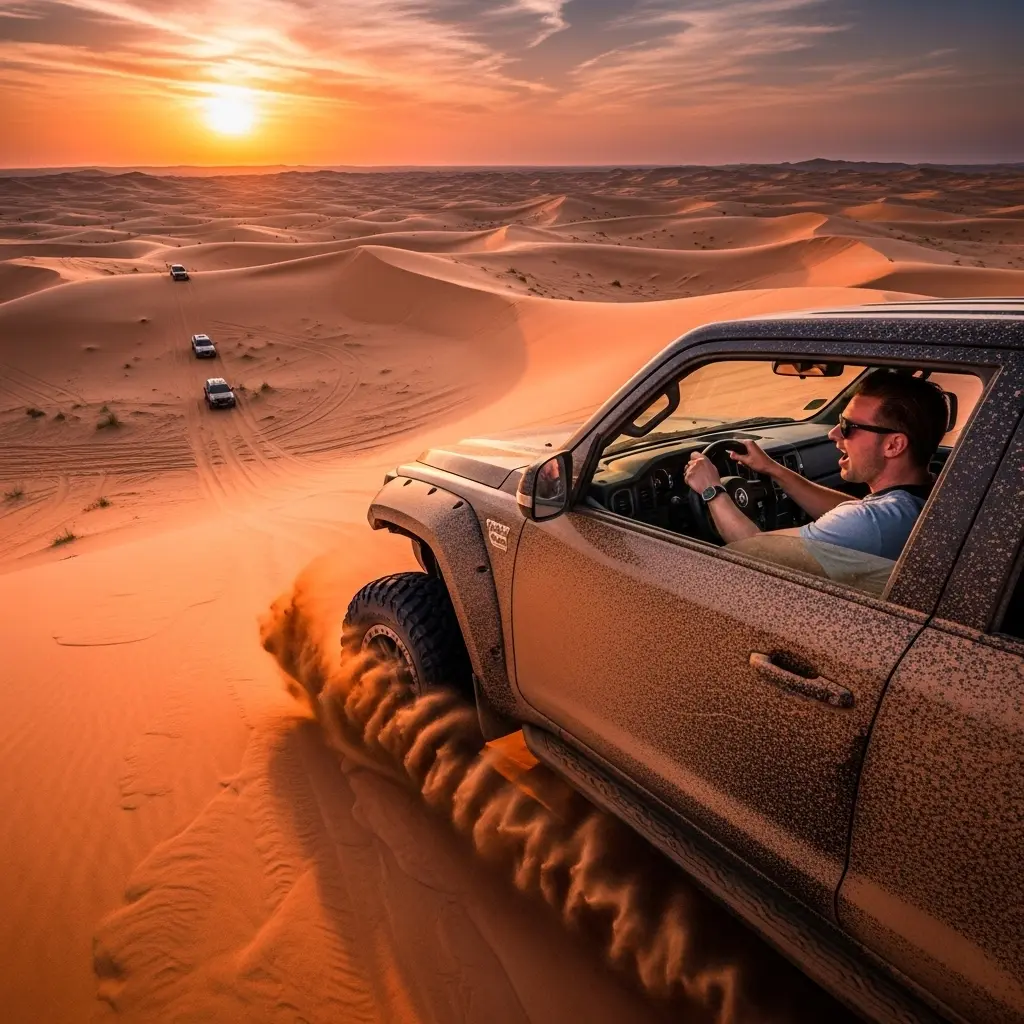
This is the appeal of a Self Drive Desert Safari.
It is man and machine against nature.
It is a test of skill.
It is a test of nerve.
And the reward is total freedom.
You can go where the tour buses cannot.
You can find the secret spots.
You can camp where no one else camps.
However, the desert is unforgiving.
Driving on sand is an art form.
It is not like driving on the highway.
If you make a mistake, you get stuck.
Or worse, you damage your car.
That is why you need this guide.
We have compiled the ultimate manual for off-road enthusiasts.
We will cover the best cars to rent.
We will teach you the physics of sand driving.
We will show you the hidden routes.
Whether you have your own Jeep or need to rent one.
This post will turn you from a novice into a sand master.
If you prefer a guided convoy for safety, check https://royaldesertadventures.ae/.
Let us deflate the tires and hit the dunes.
Why Choose a Self Drive Adventure?
Most tourists book a package tour.
They get picked up, driven around, and dropped off.
This is easy.
But a Self Drive Desert Safari is rewarding.
It builds confidence.
Learning to navigate the dunes is a life skill.
It connects you to the vehicle.
You learn to listen to the engine.
You learn to feel the traction.
It allows you to escape the crowds.
Commercial tours stick to specific “playgrounds”.
These areas are crowded with hundreds of Land Cruisers.
When you drive yourself, you can go to the empty quarter.
You can find silence.
You can set your own pace.
If you want to stop for a photo, you stop.
If you want to spend an hour watching a lizard, you can.
There is no schedule.
There is only you and the horizon.
The Right Vehicle: What You Need
You cannot take a sedan into the desert.
You will get stuck in the first meter.
You need a proper 4×4.
Not all SUVs are 4x4s.
Make sure the car has “Low Range” gears.
This is essential for a Self Drive Desert Safari.
The Legends of the Sand
Toyota Land Cruiser:
This is the King of the Desert.
It is reliable.
It has plenty of power.
It is comfortable.
Most tour operators use this for a reason.
Nissan Patrol:
This is the local favorite.
The engine is powerful (especially the V8).
It floats over the sand.
It is tough as nails.
Jeep Wrangler:
This is the fun option.
It is lighter than the others.
It is agile.
You can take the roof off.
It feels more connected to the terrain.
Ford Raptor:
This is for high-speed desert running.
The suspension is incredible.
It can handle jumps.
But it is wide, which can be tricky on narrow crests.
If you do not own one, you can rent.
However, standard rental companies do not allow off-roading.
You must go to specialist off-road rental agencies.
They equip the cars with cages and GPS.
Check rental options via https://dubaidesertsafarie.com/.
Essential Gear: Don’t Leave Home Without It
You are going into a hostile environment.
Preparation saves lives.
You need more than just water.
Here is your Self Drive Desert Safari checklist.
Tire Pressure Gauge:
You need to lower your tire pressure.
You need to measure it accurately.
Deflator:
This tool lets air out fast.
Using a key takes too long.
Air Compressor:
When you get back to the road, you must inflate.
Driving on deflated tires on asphalt is dangerous.
Shovel:
You will get stuck.
It is a matter of “when”, not “if”.
A shovel helps you dig out the wheels.
Tow Rope (Snatch Strap):
If someone needs to pull you out.
Make sure it is rated for your vehicle’s weight.
Do not use a rigid chain.
Flags:
A tall flag on a pole is mandatory.
It lets other drivers see you over the dune crests.
This prevents head-on collisions.
Communication:
Mobile signal is spotty.
A UHF radio is good if you are in a group.
A satellite phone is best for deep desert trips.
The Art of Deflating Tires
This is the first rule of the sand.
You must lower your tire pressure.
Why?
It increases the surface area of the tire.
It makes the tire wider.
This allows the tire to float on top of the sand.
If you keep road pressure, the tire cuts into the sand.
You dig a hole and get stuck.
For a Self Drive Desert Safari, aim for 15 PSI.
If the sand is very soft, go down to 12 PSI.
Do not go lower than 10 PSI unless you have bead-lock wheels.
If you go too low, the tire can pop off the rim.
That is a major headache to fix.
Deflate all four tires evenly.
Do this before you enter the sand.
Do not wait until you are stuck to deflate.
Driving Technique: Momentum is Key
Sand creates resistance.
It grabs your wheels.
You need momentum to keep moving.
But momentum does not mean speed.
You need controlled forward motion.
If you stop on an uphill slope, you are stuck.
Always stop on a downhill slope.
Or stop on flat, hard ground.
When climbing a dune, keep the throttle steady.
Do not floor it.
If you spin the wheels, you dig in.
If you feel the car slowing down, turn the steering wheel left and right.
This helps the tires find fresh traction.
This is the core skill of a Self Drive Desert Safari.
It takes practice.
Start on small dunes.
Get a feel for the car’s weight.
Learn how much gas you need.
Cresting a Dune: The Danger Zone
Crossing the top of a dune is tricky.
If you go too fast, you fly.
Landing a heavy car is bad news.
You can break the suspension.
You can hurt your spine.
If you go too slow, you get “high-centered”.
The belly of the car sits on the sand.
The wheels hang in the air.
You are stuck.
The trick is to approach with speed.
Then lift off the gas just before the top.
Let the momentum carry you over.
As the nose drops, gently apply gas again.
Always cross a dune straight on.
Never drive sideways on a steep slope.
The car can roll over.
Rolling over is the biggest risk in a Self Drive Desert Safari.
Always keep the nose pointing up or down.
The Best Location: Al Qudra Desert
For beginners, Al Qudra is perfect.
It is close to the city.
The dunes are white and manageable.
There are tracks to follow.
It is popular, so help is nearby.
You can visit the Love Lakes.
You can see the wildlife.
It is a great place to practice.
There are also flat areas for picnicking.
It is safe for families.
However, on weekends it gets busy.
Watch out for other drivers.
Watch out for campers.
The Best Location: Fossil Rock
For intermediate drivers, head to Sharjah.
Fossil Rock offers red sand.
The dunes are bigger.
There are rocky outcrops to navigate.
It requires more skill.
The view from the top is amazing.
You can see the fossils in the rocks.
They are millions of years old.
This area is scenic.
It is great for photography.
The sand here is softer than Al Qudra.
You need to be more careful with your Self Drive Desert Safari technique.
Always go with a second car here.
Do not go alone.
The Best Location: Big Red (Al Badayer)
This is for the pros.
Big Red is a massive dune.
It is famous.
Locals call it “Al Hamar”.
It attracts the best drivers.
It attracts the most powerful buggies.
Climbing Big Red is a badge of honor.
It is steep.
It is high.
If you lose momentum, you slide back down.
Only attempt this if you are experienced.
Or if you have a guide.
The area around Big Red is an off-road playground.
There are many bowls and ridges.
It is adrenaline central.
Check tour options to this area at https://hafiztourism.com/.
Recovery Basics: Unsticking Yourself
You are stuck.
Don’t panic.
It is part of the Self Drive Desert Safari fun.
First, stop spinning the wheels.
Spinning just digs you deeper.
Get out and look.
Is the chassis touching the sand?
If yes, you need to dig.
Use your shovel.
Clear the sand from under the car.
Clear the sand from in front of the tires.
Try to reverse.
Often, backing up is easier than going forward.
Follow your own tracks.
If that fails, lower your tire pressure more.
Go down to 10 PSI.
Try again.
If you have MaxTrax or recovery boards, use them.
Place them under the wheels.
Drive slowly onto them.
If all else fails, use the snatch strap.
Signal another car.
Attach the strap to the rated recovery points.
Not the bumper!
The other car pulls gently.
Once you are out, say thank you.
The Convoy Rule: Never Go Alone
The desert is lonely.
If your car breaks down, you are in trouble.
Heatstroke kills fast.
Dehydration kills fast.
The golden rule of a Self Drive Desert Safari is:
Never go alone.
Always have at least two cars.
Three is better.
If one car gets stuck, the other pulls it out.
If one car breaks, the other takes you home.
It is also more fun with friends.
You can help each other spot obstacles.
You can share the experience.
If you don’t have friends with 4x4s, join a club.
There are many off-road clubs in Dubai.
They organize weekend trips.
They welcome newcomers.
They teach you the ropes.
GPS and Navigation
It is easy to get lost.
Every dune looks the same.
There are no road signs.
Standard Google Maps does not work well in deep sand.
You need off-road navigation apps.
Apps like Gaia GPS or Wikiloc.
Download the maps offline.
Mobile signal might drop.
Always mark your entry point.
Mark the location of the road.
Keep an eye on the sun.
Know which direction is North.
If you get lost, stay with your car.
A car is easier to spot from the air than a person.
Do not walk away to find help.
You will run out of energy.
Wait for rescue.
Legal and Insurance Considerations
This is boring but vital.
Does your insurance cover off-roading?
Most standard policies do NOT.
If you crash in the dunes, you pay.
Recovery trucks charge a lot to come into the desert.
You can buy off-road insurance add-ons.
Check your policy carefully.
If you are renting, read the contract.
Most rental contracts strictly forbid off-road driving.
If you break this rule, you lose your deposit.
You are liable for the full cost of the car.
That is why specialized rentals are key.
They provide the insurance for a Self Drive Desert Safari.
It costs more, but it is safe.
Respecting the Environment
The desert is an ecosystem.
It is fragile.
Do not throw trash.
Plastic kills camels.
Take your garbage home.
Do not chop down trees for firewood.
The Ghaf tree is protected.
Do not drive over vegetation.
Plants hold the sand together.
Animals live in the bushes.
Respect the wildlife.
Do not chase gazelles with your car.
It causes them stress.
It can kill them.
Be a responsible driver.
Leave nothing but tire tracks.
Take nothing but photos.
We support eco-friendly practices at https://royaldesertadventures.ae/.
Seasonal Guide: Winter vs Summer
Winter (October to April):
The sand is cool.
It is firmer.
This makes driving easier.
The weather is pleasant.
You can drive all day with the windows down.
Camping is amazing.
This is the best time for a Self Drive Desert Safari.
Summer (May to September):
The sand is hot.
It becomes very soft and powdery.
This makes driving much harder.
Cars overheat easily.
You overheat easily.
Only experienced drivers should go in summer.
Go very early morning or late afternoon.
Midday is dangerous.
Always bring double the water in summer.
Preparing Your Car: Maintenance Check
Before you go:
Check your coolant levels.
Check your oil.
Check your fan belt.
The desert puts stress on the engine.
High revs and low speed mean less cooling.
Make sure your air conditioning works.
Check your spare tire.
Make sure the spare is inflated.
Make sure you have the jack and wheel brace.
After the trip:
Wash the car.
Especially the underbody.
Sand gets everywhere.
Check the air filter.
Sand clogs the filter and kills the engine.
Clean or replace the filter after a heavy trip.
Inflate tires back to road pressure immediately.
Guided Self-Drive Tours
If you are nervous, there is a middle ground.
You can book a “Guided Self-Drive”.
You drive your own car (or a rental).
But you follow a lead car driven by a pro.
The guide picks the route.
The guide handles the navigation.
The guide handles the recovery if you get stuck.
You just focus on driving.
It is the safest way to learn.
You get the thrill of the Self Drive Desert Safari.
But you have a safety net.
Many companies offer this.
It is great for corporate teams too.
The Buggy Option: Pure Adrenaline
If you don’t want to risk a car.
Rent a Dune Buggy.
These are purpose-built machines.
Can-Am Maverick or Polaris RZR.
They are incredibly fast.
They have long-travel suspension.
They have roll cages and harnesses.
They are safer than cars in many ways.
You cannot drive them on the road.
You tow them to the desert.
Or you rent them on-site.
Driving a buggy is different.
You can attack dunes harder.
You can jump.
It is a pure sport experience.
It is expensive but worth it.
Check buggy rentals at https://royaldesertadventures.ae/.
Night Driving: For the Brave
Driving at night is a whole new level.
You cannot see the depth of the dunes.
Shadows play tricks on your eyes.
You need powerful lights.
LED light bars are essential.
You must drive slower.
It is easy to fall into a hole.
However, it is exciting.
The desert is cool and quiet.
You can see the stars.
Only attempt this if you know the area well.
Do not explore new routes in the dark.
Stick to tracks you know.
Emergency Contacts
Save these numbers.
Dubai Police: 999.
Ambulance: 998.
There are also volunteer recovery groups.
Like “Desert Fellas” or “UAE Offroaders”.
They often help people for free.
Find their numbers on Facebook groups.
Save them in your phone.
But remember, signal is not guaranteed.
Tell someone where you are going.
Tell them when you will be back.
If you don’t return, they can raise the alarm.
Conclusion: The Ultimate Freedom
A Self Drive Desert Safari is the pinnacle of Dubai adventure.
It is not for everyone.
It requires effort.
It requires skill.
It requires respect for the machine and the land.
But the feeling of conquering a massive dune is unmatched.
The feeling of sitting by your car in the middle of nowhere is peaceful.
It is a story you will tell forever.
It separates the tourists from the travelers.
So, get your gear.
Find a convoy.
And head out into the sand.
The desert is waiting to challenge you.
Are you ready to accept the challenge?
Drive safe.
Have fun.
And remember, getting stuck is just the start of a good story.
For expert advice and backup, visit https://royaldesertadventures.ae/.
Check rental options at https://dubaidesertsafarie.com/ and https://hafiztourism.com/.
See you on the dunes!
Off-Road Essentials Checklist
| Item | Importance | Notes |
| Deflator | Critical | Brass screw-on type is best. |
| Gauge | Critical | Digital is more accurate. |
| Shovel | Critical | Long handle is easier on back. |
| Flag | Critical | Mandatory for safety. |
| Water | Critical | 5L per person minimum. |
| Tow Rope | High | Kinetic rope (snatch strap). |
| Compressor | High | Heavy-duty for fast inflation. |
| First Aid | High | Basic kit for cuts/burns. |
| GPS | High | Offline maps app. |
| Gloves | Medium | For handling hot sand/ropes. |
20 FAQs with Long Answers
1. Can I use my own SUV for a Self Drive Desert Safari?
Yes, you can use your own SUV, but it must be a 4-wheel drive (4WD/4×4) vehicle with a low-range transfer case. AWD (All-Wheel Drive) crossovers like the Honda CR-V or Toyota RAV4 are generally not suitable for deep soft sand as they lack the clearance and the low-range gearing required to get out of sticky situations. Vehicles like the Toyota Land Cruiser, Nissan Patrol, Jeep Wrangler, or Mitsubishi Pajero are ideal. Ensure your car is in excellent mechanical condition before attempting a Self Drive Desert Safari.
2. Do I need a special license to drive in the desert?
You do not need a special license to drive a private vehicle off-road in Dubai if you hold a valid UAE driving license or an international license recognized in the UAE. However, driving on sand is vastly different from driving on asphalt. It is highly recommended to take an introductory off-road driving course offered by many institutes in Dubai. These courses teach you the basics of deflation, dune crossing, and recovery, ensuring you have the skills to stay safe.
3. What is the best tire pressure for sand driving?
The golden rule for a Self Drive Desert Safari is to deflate your tires. For most standard SUVs and moderate sand conditions, a pressure of 15 PSI is a safe starting point. This expands the tire’s footprint, allowing it to float on the sand. If you are stuck or the sand is extremely soft (like in summer), you may need to go down to 10-12 PSI. However, be careful not to make sharp turns at very low pressures, as you risk “de-beading” the tire (the tire peeling off the metal rim).
4. What should I do if I get stuck?
Getting stuck is part of the game. First, stop accelerating immediately to avoid digging deeper. Get out and assess the situation. If you are “bellied out” (chassis on sand), use a shovel to clear sand from underneath and in front of the wheels. Try to reverse out in your own tracks. If that fails, lower tire pressure further. If you have recovery boards (MaxTrax), use them. If all else fails, use a kinetic tow rope and ask another vehicle to pull you out gently.
5. Is it safe to go alone?
No, it is never recommended to go on a Self Drive Desert Safari alone (solo vehicle). Always go in a convoy of at least two or three vehicles. If your single car breaks down, gets stuck beyond recovery, or you have a medical emergency, you could be stranded in dangerous heat without help. Having a second car ensures you have a ride back to civilization and a vehicle to help pull you out of trouble.
6. Can I rent a 4×4 for desert driving?
Standard rental companies (like Hertz, Avis) strictly prohibit off-road driving. Their insurance does not cover it, and you will be liable for all damages. However, there are specialized off-road rental companies in Dubai that offer modified Jeep Wranglers or similar vehicles specifically for desert driving. These rentals come with the necessary permits, off-road insurance, and safety gear. You can find these via specialized tourism portals or https://royaldesertadventures.ae/.
7. What are the best places for beginners?
Al Qudra Desert is the best spot for beginners. It is easily accessible, has many flat areas and smaller dunes to practice on, and is generally populated with other campers, so help is nearby. The “Pink Rock” area is also good for learning. Avoid areas like “Big Red” or “Liwa” until you have significant experience, as the dunes there are massive and technical, posing a higher risk of accidents for novices.
8. What equipment is mandatory to carry?
For a safe Self Drive Desert Safari, you must carry a tire pressure gauge, a deflator, a heavy-duty air compressor (to reinflate tires), a shovel, a kinetic tow rope (snatch strap), and rated shackles. A tall safety flag is also crucial for visibility. Additionally, bring plenty of water (more than you think you need), a first aid kit, and a fully charged mobile phone. A GPS app with offline maps is also essential.
9. Does my car insurance cover desert driving?
Most standard comprehensive car insurance policies in the UAE cover “on-road” driving only. Off-road driving is usually an exclusion. You can purchase an “off-road cover” add-on from many insurers for an extra fee. It is vital to check your policy wording carefully. Even with cover, some insurers may not cover “adventure driving” or racing. If you damage your car without this cover, you will have to pay for all repairs and recovery costs yourself.
10. How do I navigate in the desert?
There are no road signs in the dunes. Visual navigation can be confusing as landmarks look similar. You should use a dedicated GPS device or a smartphone app like Gaia GPS, Wikiloc, or Google Maps (Satellite View) with offline areas downloaded. Always mark your entry point (where the tarmac ends) so you can navigate back to it. Keeping track of the sun’s position also helps with general orientation (East in morning, West in evening).
11. What is the “Golden Rule” of dune crossing?
The Golden Rule is to always cross a dune straight on (perpendicular to the ridge). Never drive sideways across the face of a steep dune. If you drive sideways, gravity pulls the car down while the tires grip, creating a high risk of rolling the vehicle over. If you feel the car tipping, always steer down the slope (turn into the slide) to regain stability, never steer up.
12. Can I take children on a self-drive safari?
Yes, you can take children, provided they are properly restrained. Use car seats and seatbelts at all times, just like on the road. Drive cautiously and avoid extreme dune bashing with young kids to prevent motion sickness and neck injuries from sudden jolts. Ensure the child locks are on. It is a great family experience, but the driver must prioritize the comfort and safety of the passengers over adrenaline.
13. What happens if I break down in the desert?
If you cannot fix the issue, you will need a recovery service. There are professional desert recovery companies that charge a fee to come and tow you out. In popular areas, friendly off-roaders will often stop to help. If you are in a convoy, your friends can tow you to the nearest road. If you are alone (which you shouldn’t be) and have no signal, stay with your vehicle, raise the hood (universal sign of distress), and wait for help.
14. Is night driving recommended?
Night driving is for experienced off-roaders only. Depth perception is severely compromised in the dark, making it impossible to read the dunes. You might drive off a steep “razorback” dune without seeing the drop. You need powerful auxiliary lighting (LED bars) to drive safely. For beginners, it is best to be out of the dunes before sunset or set up camp and stop driving once it gets dark.
15. How much fuel do I need?
Sand driving consumes significantly more fuel than highway driving—often double or triple the consumption. The engine works harder, and you use lower gears. Always enter the desert with a full tank of petrol. If you are planning a long expedition deep into the desert, carry extra jerry cans of fuel. Running out of gas in the middle of the dunes is a preventable emergency.
16. What is “Camel Grass” and why should I avoid it?
Camel grass grows on mounds of sand that become very hard and bumpy. Hitting a clump of camel grass at speed is like hitting a concrete block. It can damage your suspension or bumper. It is also an ecosystem for small animals. Avoid driving over vegetation for both environmental reasons and to protect your car from unnecessary damage.
17. Can I camp anywhere?
In Dubai, camping is generally allowed in open desert areas like Al Qudra and near Fossil Rock. However, there are rules. You cannot camp on private property or restricted military zones. Fires must be in a container (fire pit), not directly on the sand. You must take all your trash with you. Recently, some areas require permits for overnight camping, so checking the latest Dubai Municipality regulations before your Self Drive Desert Safari is wise.
18. Why should I use Royal Desert Adventures?
Even if you want to drive yourself, https://royaldesertadventures.ae/ can support you. We offer “lead car” services where our professional guide drives ahead, and you follow in your own vehicle. This gives you the thrill of driving without the stress of navigation or getting stuck alone. We also provide recovery support and can organize the camping setup for you, so you just arrive and enjoy the drive.
19. How do I avoid overheating my car?
Driving in low gear with high RPMs in hot weather generates immense heat. Monitor your temperature gauge closely. If it starts to climb, stop on flat ground, open the hood, and let the engine idle (do not turn it off immediately as the fan needs to run). Turn off the AC to reduce engine load. Ensure your radiator is clean and free of sand blockage before the trip.
20. What is the best time of year for this?
The winter months (October to April) are ideal. The temperatures are cool (20-30°C), making it safe and enjoyable. The sand is also slightly firmer due to moisture. Summer (May to September) sees temperatures over 45°C. The sand becomes super soft and powdery, making driving extremely difficult and increasing the risk of getting stuck and vehicle overheating. Beginners should strictly stick to the winter season for their Self Drive Desert Safari.