
A Guide to Desert Stargazing: Discovering 11 Celestial Wonders on Safari
When the sun dips below the horizon of the Arabian desert, the adventure is far from over. As the last embers of twilight fade from the sky, a spectacle of profound beauty and immense scale is revealed. Far from the dazzling glow of Dubai’s city lights, the desert unveils its greatest secret: a breathtaking canopy of stars, planets, and galaxies. Desert stargazing is not just an activity; it’s a journey back in time and a humbling connection to the cosmos.
For most city dwellers, the true majesty of the night sky is a forgotten wonder, washed out by the glare of urban life. A desert safari, particularly an overnight experience, offers the rare and precious opportunity to witness it in all its glory.
This guide is your complete companion to the celestial wonders that await you. We will explore why the desert is the perfect observatory, delve into the cultural significance of the stars for the Bedouin people, and identify 11 incredible sights you can discover on a clear desert night. This is your invitation to experience the ultimate desert stargazing adventure.
Why the Arabian Desert is a World-Class Stargazing Destination
To appreciate the show, you must first understand why the venue is so perfect. The quality of a stargazing experience is determined by one primary factor: darkness.
The Enemy of the Stars: Light Pollution
The biggest obstacle to seeing the night sky is light pollution. The collective glow from streetlights, buildings, and advertising in a major metropolis like Dubai creates a bright haze that blankets the sky, washing out all but the brightest stars and planets.
The Desert’s Threefold Advantage
The Arabian desert offers the perfect antidote to light pollution, providing a pristine canvas for the stars.
- Distance from the City: A quality desert safari takes you far enough away from the city that its light dome sinks below the horizon, revealing the darkness needed for the stars to shine.
- Low Humidity: The arid desert air contains very little moisture. Water vapor in the atmosphere can blur and obscure starlight, so the dry air of the desert leads to exceptionally clear and crisp views.
- Vast, Unobstructed Horizons: The low, rolling dunes provide a 360-degree, unobstructed view of the celestial sphere, from horizon to horizon.
The Stars as a Compass: Bedouin Astronomy and Heritage
Long before GPS, the Bedouin people were master astronomers. For them, desert stargazing was not a hobby but an essential skill for survival, navigation, and timekeeping.
Navigation by Starlight
In the seemingly featureless expanse of the desert, the stars were a reliable map. The North Star, Polaris, was used to find the direction of north, while other constellations were used as signposts on long trade journeys across the peninsula.
A Calendar in the Sky
The rising and setting of specific stars and constellations, like the Pleiades (known as Thurayya in Arabic), marked the changing of the seasons. This celestial calendar guided everything from the timing of planting and harvesting in oases to the best periods for travel. The ability to read the sky was a vital part of life.
Your Guide to the Desert Night Sky: 11 Wonders to Look For
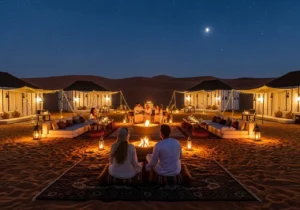
Once you arrive at a remote desert camp, like the ones used for an overnight safari with https://royaldesertadventures.ae/, the show begins. The first rule of desert stargazing is to give your eyes time to adapt. Turn off your phone, step away from the campfire, and allow at least 20 minutes for your pupils to fully dilate. The difference this makes is astounding.
Here are 11 incredible celestial sights you can spot with your naked eye.
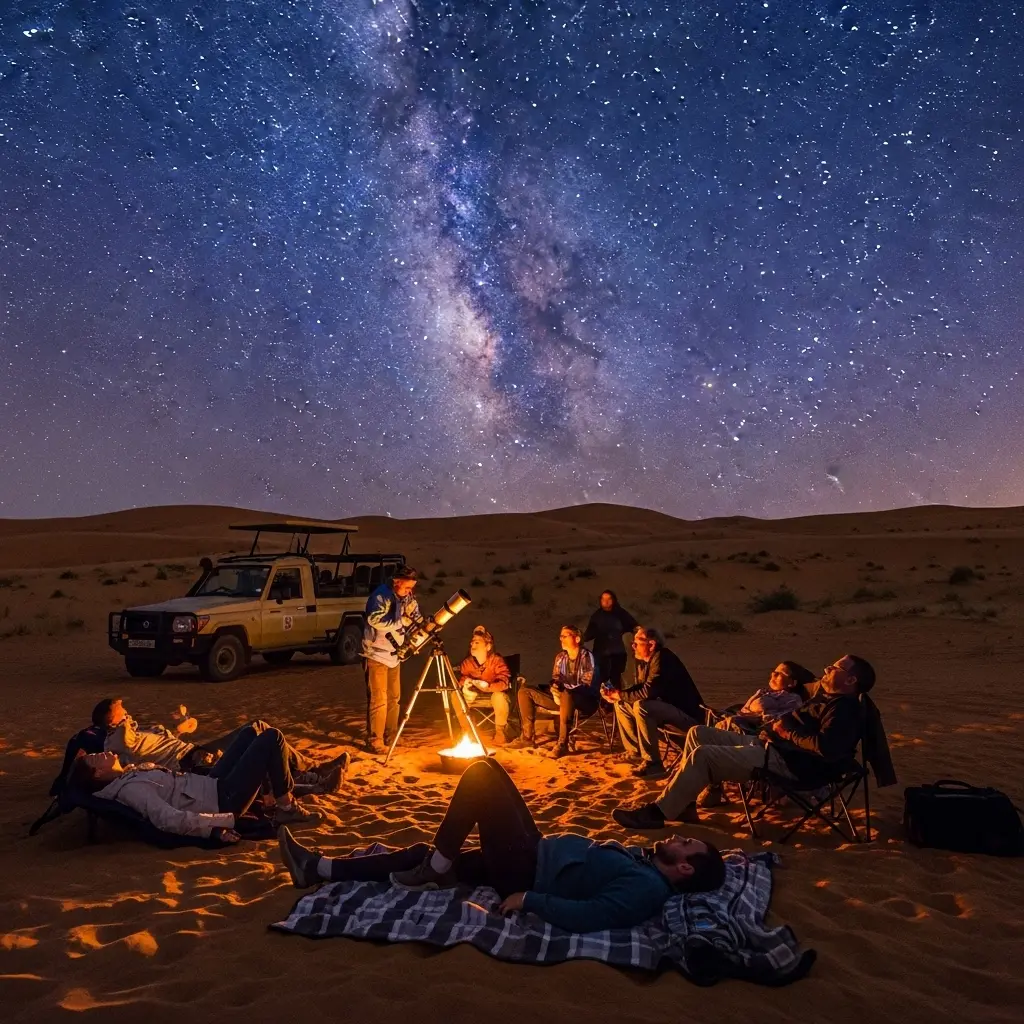
1. The Milky Way Galaxy: The ultimate prize. This is the glowing, hazy band of light that stretches across the sky. It is not a cloud, but the collective light of billions of distant stars in our own galaxy. It’s only visible in truly dark skies and is a breathtaking, humbling sight.
2. The North Star (Polaris): A historically crucial star for navigation. Find the Big Dipper, and follow the two stars at the end of its “cup” in a straight line to find this surprisingly modest but important star.
3. The Planet Venus: Often called the “Evening Star” or “Morning Star,” Venus is the brightest object in the sky after the sun and moon. It will appear as a brilliant, steady, silver light, usually visible shortly after sunset or before sunrise.
4. The Planet Jupiter: The king of the planets, Jupiter, also shines as a very bright, steady, white light. It is often the second brightest planet visible.
5. The Planet Mars: Look for a distinct and steady reddish-orange light. The Red Planet’s color is easily noticeable and sets it apart from the twinkling white of the stars.
6. The Orion Constellation (Winter): The most recognizable winter constellation. Look for Orion’s Belt, a straight line of three bright stars. From the belt, you can trace out his shoulders and feet, and even spot the fuzzy patch of the Orion Nebula, a stellar nursery where new stars are being born.
7. The Taurus Constellation (Winter): Follow Orion’s Belt upwards to find a bright, reddish-orange star named Aldebaran, which marks the eye of the bull. This V-shaped cluster of stars is a beautiful sight.
8. The Pleiades Star Cluster: Also known as the Seven Sisters, this is a stunning, jewel-like cluster of young, hot, blue stars. To the naked eye, it looks like a tiny, misty patch of light.
9. The Scorpio Constellation (Summer): In the summer months, look for a large, J-shaped constellation that truly resembles a scorpion. Its heart is marked by the bright, red supergiant star Antares.
10. The Summer Triangle (Summer): This is not a constellation but a large pattern (an asterism) made of three brilliant stars from three different constellations: Vega, Deneb, and Altair. They are among the brightest stars in the sky and dominate the summer nights.
11. Meteor Showers: If you time your trip right, you could witness a meteor shower. Major annual showers like the Perseids (August) and the Geminids (December) can produce dozens of shooting stars per hour, a truly magical part of any desert stargazing experience.
How to Get the Best Stargazing Experience
Why the Overnight Safari is the Ultimate Choice
While a standard evening safari takes you away from the city, the camp itself still has lights for dinner and entertainment. The absolute best desert stargazing happens in the middle of the night, long after the evening guests have departed and the camp lights are turned off. An overnight desert safari is, without a doubt, the premier choice for anyone serious about seeing the night sky.
Choosing the Right Operator
Select an operator whose camp is located deep within the desert, far from any highways or towns. When browsing options on platforms like https://dubaidesertsafarie.com/ or https://hafiztourism.com/, look for descriptions that emphasize the remoteness of the camp. Ask your potential provider, “How far is your camp from city lights?” A quality operator will understand and appreciate this question.
Conclusion: A Connection to the Cosmos
Desert stargazing in Dubai offers a profound escape. It is a journey that takes you millions of light-years away while grounding you in the ancient traditions of the Bedouin. It’s an opportunity to witness the universe in its raw glory, a spectacle of unimaginable beauty that costs nothing but your time and attention. By choosing an overnight safari and allowing your eyes to adjust to the magnificent darkness, you are not just looking at the stars; you are experiencing a deep and lasting connection to the cosmos and to the timeless soul of the desert itself.
Frequently Asked Questions (FAQs)
1. What is the best month of the year for desert stargazing in Dubai? The winter months, from October to March, are generally the best. The air is less hazy and the cooler temperatures make for a more comfortable experience. This period also features the spectacular winter constellations like Orion. However, the summer offers clear views of the Milky Way’s bright core and constellations like Scorpio.
2. Can I really see the Milky Way with the naked eye? Yes, absolutely. On a clear, moonless night in a location far from city lights—like on a quality overnight desert safari—the Milky Way is clearly visible as a faint, glowing band of light stretching across the sky. It is one of the most breathtaking sights you will ever see.
3. Do I need a telescope or binoculars to enjoy the experience? While a telescope or binoculars will certainly enhance the view, allowing you to see Jupiter’s moons or details in the Orion Nebula, they are not necessary for a wonderful experience. A great desert stargazing session can be had with the naked eye alone, simply by lying back on a carpet and taking in the vast panorama.
4. What is a “red light” flashlight and why is it important? A red light flashlight is a torch that uses a red bulb or a red filter. Red light has a minimal impact on your night vision. Using a normal white light flashlight, or even your phone screen, will instantly contract your pupils and ruin your dark adaptation, making it difficult to see faint stars for another 20-30 minutes.
5. Is it safe to be in the desert at night for stargazing? Yes, it is extremely safe when you are with an organized tour. The safari camps are secure, and the guides are professionals. You are not wandering alone in the wilderness. It is a very safe and serene environment.
6. How much does the phase of the moon affect stargazing? The moon’s phase has a massive impact. A full moon is so bright that it acts like a giant natural streetlight, washing out the fainter stars and the Milky Way. The best time for desert stargazing is during the new moon phase, or the week before and after it, when the sky is at its darkest.
7. Are there any stargazing apps you would recommend? Yes, there are many excellent and user-friendly stargazing apps for smartphones, such as SkyView Lite, Star Walk 2, and Stellarium. You can simply point your phone at the sky, and the app will identify the stars, planets, and constellations you are looking at. Remember to use the app’s “night mode,” which turns the screen red to preserve your night vision.
8. What is the difference between a star and a planet when looking at them? The easiest way to tell the difference is that stars twinkle, while planets do not. Stars are so far away that their light is easily disturbed by the Earth’s atmosphere, causing the twinkling effect. Planets are much closer, appearing as steady, solid points of light.
9. Can I take photos of the stars with my smartphone? It is challenging but can be possible with the latest high-end smartphones that have advanced “night mode” or “pro mode” settings. You will need to mount your phone on a small, stable tripod and use a long exposure setting to capture enough light from the stars.
10. What is a “constellation”? A constellation is a group of stars that forms an imaginary outline or pattern on the celestial sphere, typically representing an animal, mythological person or creature, or an inanimate object. They were created by ancient cultures to help them remember and navigate the night sky.
11. Do the entertainment lights at the safari camp interfere with stargazing? Yes, they do. This is why the best desert stargazing happens on an overnight safari. After the evening guests leave and the dinner and shows are over, the main generator and lights at the camp are switched off, plunging the area into the deep darkness required for a spectacular view.
12. Will the safari guide know about the stars? Guides on a premium overnight desert safari from a reputable company like https://royaldesertadventures.ae/ are often trained in basic astronomy and can point out the major constellations and planets. They can also share the traditional Bedouin stories associated with the stars.
13. What is the Zodiacal Light? This is a faint, triangular glow that can sometimes be seen in the west after sunset or in the east before sunrise on a very dark, clear night. It is caused by sunlight scattering off dust particles in our solar system. Seeing it is a sign of an exceptionally dark and clear sky.
14. Can I see satellites or the International Space Station (ISS)? Yes. You can often see satellites moving steadily and silently across the sky. The ISS is also visible and looks like a very bright, fast-moving star. There are apps and websites that can tell you the exact times the ISS will be passing over your location.
15. What should I wear for a night of stargazing in the desert? Dress in warm layers. Even after a hot day, the desert temperature can drop significantly at night. A warm fleece jacket, a beanie, and even a light blanket can make the experience much more comfortable, allowing you to relax and enjoy the show for longer.
16. What is the difference between a meteor and a meteorite? A meteor is the streak of light you see when a small piece of space debris burns up upon entering Earth’s atmosphere (a “shooting star”). A meteorite is the rare piece that survives the journey and physically lands on the Earth’s surface.
17. What is the best way to lie back and watch the sky? The camps on an overnight safari will have carpets and cushions. The best way is to lie down on a carpet, perhaps using a cushion for your head, so you don’t have to crane your neck. This allows for a comfortable and immersive viewing experience.
18. Will the tour provide any stargazing equipment? Most standard tours do not. The experience is focused on naked-eye stargazing. Some very specialized or luxury astronomical tours may provide telescopes or binoculars, but you should not expect this as a standard feature.
19. How long does it take for my eyes to adapt to the dark? It takes approximately 20 to 30 minutes for your eyes to become fully “dark-adapted” and for your pupils to open to their maximum size. During this time, it is crucial to avoid looking at any bright white lights, including your phone screen.
20. Is the experience suitable for children? Yes, desert stargazing is a wonderful and educational experience for children. It can spark a lifelong interest in science and astronomy. The sheer wonder of seeing the Milky Way for the first time is a magical memory for a child.