

Life After Sunset in Dubai Desert: 15 Secrets of the Nocturnal Sands
The sun dips below the horizon.
The sky turns a deep, bruised purple.
The heat of the day begins to fade.
Most tourists think the desert goes to sleep when the sun sets.
They pack up their cameras.
They get back in their Land Cruisers.
They head back to the city lights.
They are making a mistake.
The desert does not sleep.
It wakes up.
Life After Sunset in Dubai Desert is a completely different world.
It is a world of shadows and silence.
It is a world of movement and mystery.
While the day belongs to the heat and the machines.
The night belongs to the creatures and the stars.
If you really want to understand the Arabian wilderness.
You must stay after dark.
You must listen to the wind when the engines stop.
This guide is your portal to the dark side of the dunes.
We will explore the biological miracles of nocturnal animals.
We will look at the astronomy of the desert sky.
We will tell the stories that Bedouins only whisper by the fire.
When you book with https://royaldesertadventures.ae/, you can choose to stay.
You can choose to see what really happens when the lights go out.
Let us step into the darkness.
The Great Temperature Shift
The first thing you notice is the air.
During the day, the sun is a physical weight.
It presses down on you.
Sand reflects the heat.
But sand has a low specific heat capacity.
This means it does not hold onto heat well.
As soon as the radiation source (the sun) is gone.
The heat escapes into the atmosphere.
This causes a rapid drop in temperature.
In winter, it can go from 30°C to 10°C in hours.
This thermal shock is the defining feature of Life After Sunset in Dubai Desert.
It triggers a change in behavior for every living thing.
Plants open their pores.
Animals come out of their burrows.
Humans gather around fires.
This drop in temperature makes the environment hospitable.
It becomes a pleasant place to be.
The air feels crisp.
It feels clean.
It is a relief for your lungs after the dusty heat of the day.
The Awakening of the Nocturnal Army
You might think the desert is empty.
During the day, it looks lifeless.
But under the sand, thousands of hearts are beating.
They are waiting for the signal.
The sunset is that signal.
The first to emerge are often the insects.
Darkling beetles scuttle across the cooling sand.
They are looking for food.
Then come the hunters.
The Arabian Sand Scorpion is nocturnal.
It glows under UV light.
It hunts insects and small lizards.
Then come the mammals.
The desert is home to the Cheesman’s Gerbil.
It is a small rodent.
It comes out to gather seeds.
But where there is prey, there are predators.
The Desert Fox (Rüppell’s Fox) emerges.
It has huge ears.
These ears help it dissipate heat.
But they also help it hear the tiny footsteps of a gerbil.
The Sand Cat is another ghost of the dunes.
It looks like a house cat but is a fierce hunter.
Seeing these animals requires patience.
It requires silence.
In a Life After Sunset in Dubai Desert safari, you use red lights.
White light scares them.
Red light is less visible to their eyes.
You sit and watch.
The desert floor becomes a busy highway of life.
The Symphony of Silence
We live in a world of noise.
Traffic.
Air conditioning.
Phones.
We forgot what silence sounds like.
In the deep desert at night, the silence is physical.
It presses against your ears.
It is heavy.
But it is not empty.
If you listen closely, you hear the “sound of silence”.
You hear the wind shifting the grains of sand.
You hear the dry rustle of a bush.
You might hear the call of a desert owl.
This acoustic environment is rare.
It forces your brain to slow down.
It reduces stress hormones.
It is a form of natural therapy.
Many people find this aspect of Life After Sunset in Dubai Desert the most moving.
It is a chance to reconnect with your own thoughts.
It is a chance to just be.
The Celestial Ceiling: Astronomy
In the city, we see maybe 10 stars.
The light pollution washes out the universe.
In the desert, the sky is black ink.
The stars are diamond dust.
You can see the Milky Way.
It looks like a cloudy band stretching across the sky.
You can see thousands of stars with the naked eye.
The constellations are clear.
Orion stands tall in the winter sky.
Scorpius dominates the summer.
Planets like Jupiter and Venus shine like lamps.
This view has guided humans for millennia.
Bedouins used the stars for navigation.
They did not have GPS.
They knew the sky like the back of their hand.
During your trip with https://royaldesertadventures.ae/, we can show you this.
We can point out the North Star.
We can show you the navigation stars.
It connects you to the ancient history of travel.
It makes you feel small.
It makes you feel infinite.
The Bedouin Campfire Tradition
Fire is the heart of the desert night.
It provides warmth.
It provides light.
It provides safety.
Gathering around a fire is a primal instinct.
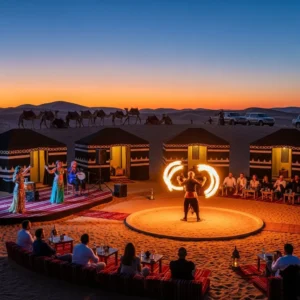
In our camps, we light a bonfire every night.
Guests sit around it on cushions.
This is where the culture comes alive.
The fire is where stories are told.
Bedouin culture is an oral tradition.
They did not write books.
They memorized poetry.
They told tales of ancestors and battles.
Sitting by the fire, sipping hot tea.
Listening to the crackle of the wood.
This is the essence of Life After Sunset in Dubai Desert.
It is social.
Strangers become friends.
You share warmth and stories.
It is simple hospitality.
But it is profound.
The Mystery of the Jinn
The desert has a spiritual side.
In local folklore, the desert is the home of the Jinn.
Jinn are supernatural beings in Islamic mythology.
They are made of smokeless fire.
They live in a parallel world.
Bedouins believe the Jinn inhabit the empty places.
They live in the ruins.
They live in the deep dunes.
At night, the desert feels mysterious.
Shadows play tricks on your eyes.
A bush might look like a person.
The wind might sound like a whisper.
These stories add a layer of thrill to the night.
Guides often share spooky tales by the fire.
Stories of travelers who followed a strange light.
Stories of voices calling from the dunes.
It is part of the cultural fabric.
It makes you respect the darkness.
It reminds you that we are guests in this environment.
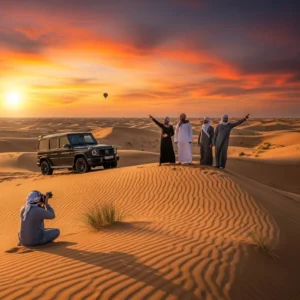
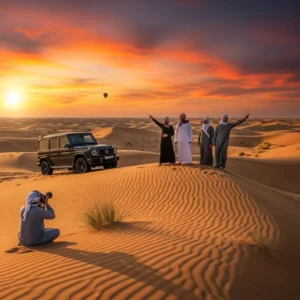
Nocturnal Photography
Taking photos at night is an art.
The camera sees differently than the eye.
With a long exposure, you can capture the movement of the stars.
You can create “Star Trails”.
These are circular lines of light in the sky.
You can capture the texture of the sand under moonlight.
The moon acts like a giant softbox.
It creates gentle shadows.
It illuminates the dunes in silver.
If you are a photographer, Life After Sunset in Dubai Desert is a playground.
You need a tripod.
You need patience.
But the results are stunning.
You can also try “Light Painting”.
Use a torch to draw shapes in the air while the shutter is open.
Write your name in fire.
Draw a heart around your partner.
It is fun and creative.
Night Driving and Navigation
Driving in the dunes at night is dangerous.
You lose depth perception.
Shadows hide the drops.
A dune that looks flat might be a cliff.
However, expert drivers know how to do it.
They use powerful LED light bars.
These lights cut through the darkness.
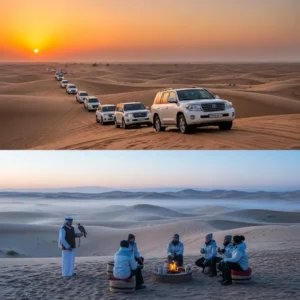
Seeing a convoy of cars moving through the night is spectacular.
It looks like a scene from a sci-fi movie.
The beams of light sweep across the sand.
It requires high skill.
The driver must know the terrain by memory.
They must trust their instincts.
For a tourist, a night drive is exhilarating.
It feels faster than in the day.
Your senses are heightened.
You hold on tighter.
But only go with professionals like those at https://dubaidesertsafarie.com/.
Never attempt to drive yourself at night.
It is too easy to get lost.
The Plant Life Respiration
Plants breathe too.
During the day, desert plants close their pores.
They want to keep water inside.
At night, they open up.
They absorb the carbon dioxide.
Some plants bloom only at night.
This preserves their pollen from the heat.
If you walk near the vegetation at night, you might smell it.
The scent of desert herbs is stronger in the cool air.
Plants like the Desert Hyacinth might release fragrance.
This adds an olfactory dimension to the experience.
It smells earthy and sweet.
It is the smell of the desert waking up.
The Danger: Snakes and Scorpions
We must be honest.
The night also brings out the dangerous creatures.
The Arabian Sand Viper is nocturnal.
It buries itself in the sand with only eyes showing.
The Deathstalker Scorpion is also active.
They are hunting.
This is why safety rules are strict.
Do not walk barefoot at night away from the camp.
Wear closed shoes.
Do not put your hands in bushes.
Do not turn over rocks.
However, in the tourist camps, it is safe.
The vibrations of walking people keep snakes away.
The lights keep them away.
The staff checks the area regularly.
Sightings are very rare.
But being aware is part of Life After Sunset in Dubai Desert.
It adds a thrill of the wild.
It demands respect for nature.
The Morning Fog phenomenon
Technically, this happens just before sunrise.
But it is part of the night cycle.
In winter, the desert often gets foggy.
The cold ground cools the moist air.
Thick fog rolls in over the dunes.
It looks like a sea of clouds.
The tops of the dunes look like islands.
Being in the desert during fog is mystical.
Sound is dampened even more.
Visibility drops to a few meters.
It feels like you are in a dream.
As the sun rises, the fog burns off.
It reveals the golden sand underneath.
This transition is beautiful to watch.
It is a photographer’s dream condition.
The Cultural Significance of the Moon
The moon is vital in Arab culture.
The Islamic calendar is lunar.
Months begin when the new moon is sighted.
Ramadan starts with the moon.
Eid starts with the moon.
Bedouins used the moon as a calendar and a clock.
A full moon meant safe travel at night.
It meant cooler travel for the camels.
A new moon meant danger and darkness.
Sitting in the desert, watching the moon rise.
It connects you to this heritage.
You understand why the crescent moon is a symbol of Islam.
It is the light in the darkness.
It is the guide.
Modern Night Activities
The desert night has modernized too.
It is not just sitting and looking.
You can do activities.
Sandboarding at night is fun.
The dunes are lit by floodlights or car headlights.
Or you can do it in the dark for a challenge.
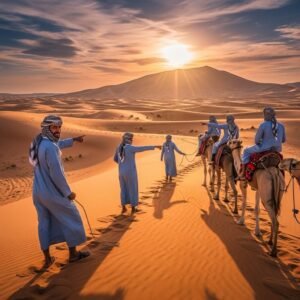
Night Camel Trekking is popular.
Riding a camel under the stars is romantic.
It is peaceful.
Some operators offer night Quad Biking.
Following a guide with lights through the dunes.
It is an adrenaline rush.
These activities give a new perspective.
The familiar dunes look alien at night.
Check activity options at https://hafiztourism.com/.
Sleeping Arrangements
If you choose to stay, where do you sleep?
Life After Sunset in Dubai Desert includes the sleepover.
You can sleep in a tent.
This protects you from the wind and dew.
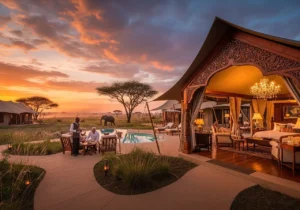
Or you can sleep in a “Glamping” pod.
These have beds and sometimes AC.
Or you can sleep “Cowboy Style”.
Just a mattress and a sleeping bag under the sky.
This is the best way.
You wake up and see the stars.
You feel the breeze on your face.
It is safe.
The camp is guarded.
It is a bucket list experience.
Waking up with sand in your hair is a badge of honor.
Why Royal Desert Adventures is Your Night Guide
We know the night.
We know the safe spots.
We know where the light pollution is lowest.
We employ guides who are passionate about astronomy.
We employ guides who know the wildlife.
https://royaldesertadventures.ae/ offers specialized overnight tours.
We ensure you are warm.
We provide plenty of blankets.
We serve hot food and drinks all night.
We manage the safety so you can relax.
We turn the scary darkness into a welcoming home.
Conclusion
The desert has two faces.
The day face is fierce and bright.
The night face is gentle and mysterious.
If you only see the day, you only know half the story.
Life After Sunset in Dubai Desert is where the magic happens.
It is where the biology, astronomy, and culture intersect.
It is an experience that touches the soul.
It quiets the mind.
It opens the eyes.
So, don’t rush back to the hotel.
Stay a little longer.
Let the darkness embrace you.
Listen to the stories of the sand.
Book your nocturnal adventure today.
Visit https://royaldesertadventures.ae/ to secure your night under the stars.
The desert is waiting for you.
But only after the sun goes down.
See you in the shadows.
Nocturnal Wildlife Checklist
| Animal | Type | Active Time | Chance of Seeing |
| Sand Fox | Mammal | Late Night | Low |
| Sand Gecko | Reptile | Evening | High |
| Scorpion | Arachnid | Night | Medium (UV Light helps) |
| Gerbil | Mammal | Night | Medium |
| Owl | Bird | Night | Low |
| Beetle | Insect | Sunset | High |
| Viper | Reptile | Night | Very Low |
20 FAQs with Long Answers
1. Is it safe to be in the desert at night?
Yes, being in the desert at night is safe if you are with a reputable tour operator. The designated campsites are secure, fenced, and guarded. There are no large predators like lions or bears. While there are snakes and scorpions, they generally avoid the busy, vibrating ground of the campsite. If you stay within the camp area and follow the guide’s instructions, you are perfectly safe.
2. How cold does it get in the desert at night?
The temperature drop can be significant. In the winter months (December to February), night temperatures can fall to 10°C or even lower. Combined with the wind chill, it can feel quite freezing. In the summer months (June to August), it stays warm, around 25°C to 30°C. Regardless of the season, it is always cooler than the city because sand radiates heat away quickly.
3. Can I see the Milky Way from the desert camp?
It depends on the location of the camp and the moon phase. Most tourist camps are within an hour of the city, so there is some light pollution on the horizon. However, the sky is still much darker than in the city. On a moonless night, you can see thousands of stars and often the faint band of the Milky Way directly overhead. For professional astrophotography, you might need to go deeper into the desert on a private tour.
4. Are there mosquitoes in the desert?
generally, mosquitoes are not a major problem in the deep desert because there is no standing water for them to breed. However, during the transition seasons or if there has been recent rain, there might be a few insects. Flies can be annoying at sunset but usually disappear at night. It is always a good idea to bring some insect repellent just in case.
5. What should I wear for a night desert safari?
You should dress in layers. Bring a warm jacket, a hoodie, or a shawl, especially in winter. Long trousers are recommended to keep your legs warm and protect them from insect bites or prickly bushes. Closed-toe shoes (sneakers) are better than sandals at night for warmth and safety when walking on the sand.
6. Do we sleep in tents or buildings?
In a standard overnight safari, you sleep in camping tents. These are usually igloo-style tents set up for you with a mattress, pillow, and sleeping bag inside. Some premium camps offer permanent structures or “glamping” pods with real beds. You can also choose to sleep outside under the stars if the weather is good, which many guests prefer.
7. Is there electricity at night?
Most camps turn off the main bright floodlights after the evening guests leave to allow for stargazing and sleeping. However, there is usually a central area with low lighting powered by solar or a generator where you can charge phones. Inside the individual tents, there is typically no electricity. Bringing a power bank is highly recommended.
8. What happens if I need the bathroom in the middle of the night?
The permanent campsites have restroom blocks with toilets and sinks. These are accessible throughout the night. It is a good idea to bring a small torch or use your phone’s light to navigate from your tent to the restroom, as the path might be dark to preserve the stargazing atmosphere.
9. Are there wild animals that attack humans?
No. The wildlife in the Dubai desert is small and shy. Foxes, sand cats, and gazelles will run away from humans. Scorpions and snakes will only sting or bite if they are threatened or stepped on. They do not hunt humans. By wearing shoes and not putting your hands in hidden places, you avoid any accidental encounters.
10. Can I drive my own car in the desert at night?
It is strongly advised NOT to drive your own car in the desert at night unless you are an expert off-roader with a convoy. Navigation is extremely difficult without visual landmarks. Depth perception is lost, making it easy to drive off a steep dune and crash. Getting stuck at night is dangerous as rescue is harder. Always go with a professional guide.
11. Is dinner included in the overnight stay?
Yes, a BBQ dinner buffet is included in the evening. There is also usually a late-night snack or tea/coffee available by the bonfire. In the morning, a freshly prepared breakfast is served. You will not go hungry. If you have specific dietary needs, inform the operator in advance.
12. Can we have a private bonfire?
Standard packages include a communal bonfire where all overnight guests gather. This is a great way to socialize. If you want a private fire for your group or a romantic setting, you usually need to book a VIP or private overnight package. This can be arranged for an extra fee.
13. Is it quiet at night?
Once the evening safari guests depart (around 9:30 PM) and the generator is turned down, the desert becomes incredibly quiet. The silence is profound and is one of the main attractions of Life After Sunset in Dubai Desert. However, if there are other camping groups nearby, there might be low conversation.
14. What time does the sun rise?
Sunrise time varies by season. In winter, it is around 7:00 AM. In summer, it is around 5:30 AM. Your guide will tell you the exact time so you can wake up and climb a dune to watch it. It is the highlight of the overnight experience.
15. Can I bring alcohol?
You cannot bring your own alcohol to the camp due to licensing laws. However, most camps have a bar where you can purchase drinks during the evening. The bar closes when the evening guests leave. If you want a drink for the late night, buy it before the bar closes.
16. Is the overnight safari suitable for children?
Yes, kids love camping. It is a great adventure. Just ensure they have warm clothes and sturdy shoes. Keep an eye on them near the fire. If your child is an infant, the lack of soundproofing and amenities might be challenging, so consider if they are comfortable with camping.
17. What do I do with my luggage?
You cannot bring large suitcases to the desert. The 4x4s don’t have space. Pack a small overnight bag or backpack with your essentials (toothbrush, warm clothes, charger). Leave your main luggage at your hotel concierge.
18. Can I see the desert fox?
It is possible but rare. They are nocturnal and very shy. They sometimes come near the edge of the camp looking for food scraps after everyone is asleep. If you are quiet and observant, you might see eyes reflecting in your torchlight.
19. Is there morning entertainment?
The morning is peaceful. There are no belly dancers or loud music. The entertainment is the sunrise, a light breakfast, and perhaps a morning camel ride or sandboarding session before heading back to the city.
20. Why choose Royal Desert Adventures for the night tour?
Choosing https://royaldesertadventures.ae/ ensures you are safe and comfortable. We provide clean sleeping gear (laundered after every use). Our staff stays on site for security. We pick the best spots for stargazing. We make sure the bonfire is warm and the breakfast is fresh. We turn a night in the wild into a cozy, memorable experience.