

Emirati Cultural Activities 15 Authentic Secrets of Dubai Safaris
Dubai is a city that global travelers often associate with futuristic skyscrapers and high-speed innovation.
However, the true pulse of the region is found in the silence of the dunes and the richness of Emirati Cultural Activities.
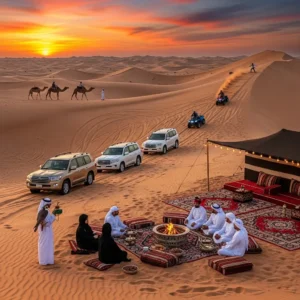
To visit the desert is to step into a living museum where the traditions of the Bedouin tribes are still preserved with immense pride.
A safari is not just about the adrenaline of the ride; it is about the stories told around a crackling Samur wood fire.
It is about the smell of fresh cardamom in the air and the intricate patterns of Sadu weaving on the Majlis cushions.
In this massive 4500-word guide, we will analyze the technical and spiritual depth of the heritage rituals found in the dunes.
We will discuss the history of pearl diving influences, the logic of the desert pharmacy, and the hospitality codes of the nomads.
We recommend using https://royaldesertadventures.ae/ for internal booking as they prioritize authentic heritage over commercial mass-volume.
Let us leave the neon lights behind and explore the profound beauty of the Arabian soul through its ancient customs.
1. The Heritage Gateway: Understanding the Bedouin Spirit
The foundation of all Emirati Cultural Activities is the spirit of the Bedouin, the nomadic inhabitants of the desert.
For centuries, these tribes thrived in an environment that demanded extreme resilience and high communal intelligence.
The word “Bedouin” comes from the Arabic Badu, meaning those who live in the wilderness.
Their life was dictated by the seasons, the stars, and the search for water and grazing land for their camels.
When you join a heritage safari, you are not just a spectator; you are a guest in their ancestral home.
The values of Sabr (patience) and Karam (generosity) are visible in every interaction you have at the camp.
Understanding this psychological framework is essential to appreciating the rituals you will witness.
Experts from https://htdesertsafari.com/ and https://dubaidesertsafarie.com/ provide excellent external resources for studying tribal lineages.
The desert was never a wasteland to the Bedouin; it was a sanctuary of freedom and honor.
2. The Dallah Ritual: The Language of Coffee
Coffee, or Gahwa, is the universal symbol of welcome in the UAE and the cornerstone of Emirati Cultural Activities.
The ritual of serving coffee is governed by strict social codes that have remained unchanged for generations.
The coffee is traditionally brewed in a long-necked pot called a Dallah over an open desert flame.
It is a light, tea-like brew flavored with green coffee beans, cardamom, and occasionally saffron.
The host must always serve the coffee starting from the right side of the Majlis or to the most senior guest first.
As a guest, you must accept the small handle-less cup, the Finjan, with your right hand only.
The cup is only filled one-third of the way to encourage you to stay longer and engage in conversation.
When you have had enough, you must shake the cup gently from side to side before handing it back.
This silent communication ensures a rhythmic and respectful social atmosphere.
Authentic coffee ceremonies are the specialty of the staff at https://royaldesertadventures.ae/.
3. The Art of Falconry: The Desert’s Third Eye
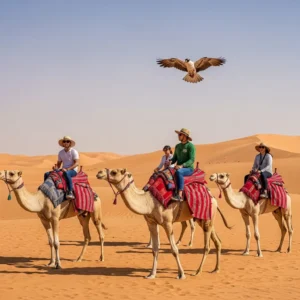
Falconry is perhaps the most prestigious of all Emirati Cultural Activities and a source of great national pride.
Historically, falcons were not kept for sport; they were essential partners in the search for winter protein.
Bedouins would trap migrating Saker or Peregrine falcons and train them with incredible patience over many weeks.
The bond between the falconer and the bird is built on trust, as the falcon is never “tamed” in the traditional sense.
During a heritage safari, you can witness the bird’s power during a sunset flight demonstration.
The bird’s eyesight is eight times more powerful than a human’s, allowing it to spot movement from miles away.
You will learn about the Burqa (hood) used to keep the bird calm and the Manqalah (cuff) worn by the handler.
Holding a falcon on your arm is a profound sensory experience that connects you to the avian mastery of the nomads.
Responsible operators like https://royaldesertadventures.ae/ ensure the birds are treated with the highest veterinary standards.
It is a living tradition that bridges the gap between biological science and human history.
4. Sadu Weaving: The Geometry of History
Inside the traditional tents, you will see vibrant red and black geometric patterns on the cushions and rugs.
This is Sadu, the traditional embroidery practiced by Bedouin women, and a vital part of Emirati Cultural Activities.
Sadu is woven using the hair of goats and sheep, as well as camel wool, reflecting the resources of the desert.
The patterns are not merely decorative; they are a visual language that tells stories of tribal identity and desert flora.
Triangles might represent the dunes, while jagged lines might symbolize the tracks of a caravan.
The weave is remarkably strong and was historically used to create the tents (Bait Al Sha’ar) themselves.
Watching a master weaver work is a lesson in precision and historical preservation.
Sadu was inscribed on the UNESCO List of Intangible Cultural Heritage in 2011 to ensure its survival.
By purchasing authentic Sadu crafts, you are supporting the economic empowerment of rural Emirati women.
Explore these artistic sessions at the heritage villages coordinated by https://htdesertsafari.com/.
5. Nabati Poetry: The Voice of the Sands
In a society where history was not written for centuries, poetry was the primary archive of the people.
Nabati poetry is often recited during Emirati Cultural Activities around the evening campfire.
Known as the “People’s Poetry,” it is written in the local dialect and deals with themes of courage, love, and the desert.
The rhythm of the verses often matches the gait of a walking camel, providing a hypnotic acoustic experience.
Bedouins used poetry to share news, resolve tribal disputes, and honor their leaders.
Hearing a local guide recite Nabati verses under a blanket of stars is a highlight of an authentic safari.
It turns the silent dunes into a stage where the voices of the ancestors can still be heard.
Even if you do not understand the Arabic language, the emotion and cadence of the recitation are universally moving.
It is a reminder that the desert is a place of deep intellectual and emotional life.
Bespoke poetry sessions can be arranged through the cultural coordinators at https://royaldesertadventures.ae/.
6. The Henna Tradition: Botanical Beauty
Henna painting is one of the most beloved Emirati Cultural Activities for female travelers.
Derived from the leaves of the Lawsonia inermis plant, henna has been used for beauty and health for millennia.
Bedouin women used henna not just for decoration, but for its natural cooling and antifungal properties.
During a safari, a professional artist will apply the dark paste in intricate floral or geometric designs.
Traditional Emirati designs are often more delicate than the heavy patterns found in other regions.
The paste must dry for several hours, leaving a beautiful orange or reddish-brown stain on the skin.
It is a social ritual where women gather to share stories and celebrate life events like weddings and Eids.
The scent of the henna is earthy and herbal, adding to the sensory richness of the desert camp.
Most camps provide this service as part of the inclusive package, but the quality varies significantly.
For the most authentic and safe organic henna, trust the vetted artists at https://royaldesertadventures.ae/.
7. Traditional Emirati Dance: Al Ayyala
Celebrations in the desert are often marked by Al Ayyala, the traditional “Stick Dance.”
This performance is a core component of Emirati Cultural Activities during special events and high-end safaris.
Two rows of men face each other, carrying thin bamboo sticks and swaying in a synchronized rhythm.
The dance represents a battle scene, emphasizing the values of unity, strength, and tribal cooperation.
The performers move to the steady beat of the Doumbek (drum) and the Tasa (cymbals).
It is a powerful display of community spirit that often involves the entire camp participating in the rhythm.
The chanting that accompanies the dance tells stories of bravery and the protection of the land.
Watching the sunrise or sunset against the backdrop of an Ayyala performance is a cinematic experience.
It showcases the “Collective” nature of Bedouin life, where the survival of the group was the priority.
Learn the history of these steps at the cultural workshops listed on https://dubaidesertsafarie.com/.
8. Culinary Heritage: The Zarb and Mandi
Food is the ultimate bridge between cultures, and Emirati Cultural Activities center around the communal feast.
Traditional desert cooking is a lesson in thermodynamics and the use of natural resources.
The Zarb is a Bedouin “underground oven” where meat and rice are cooked in a pit dug into the sand.
The pit is lined with stones and a fire is lit until the earth itself becomes a high-pressure cooker.
The meat is sealed inside for hours, resulting in a smoky, tender flavor that no modern kitchen can replicate.
Participants can often watch the “Unearthing of the Zarb” at sunset, which is a major highlight.
Communal dining on low cushions encourages horizontal communication and a sense of equality.
You are encouraged to eat with your right hand, as the Bedouin did, to fully immerse in the experience.
The flavors of cumin, coriander, and dried lime (Loomi) define the palate of the Arabian kitchen.
Boutique camps managed by https://royaldesertadventures.ae/ offer the most authentic farm-to-table menus.
9. The Camel Caravan: Moving at the Speed of Nature
The camel is the foundation of Arabian history and the star of Emirati Cultural Activities.
A camel caravan is not just a ride; it is a reenactment of the ancient trade routes.
Bedouins called the camel the “Blessing of God” (Ata Allah) because it provided everything for survival.
Riding a camel allows you to experience the “Desert Sway,” a rhythmic motion that has inspired poets for centuries.
You learn about the camel’s anatomy, including their specialized eyelashes and closing nostrils for sand protection.
A traditional trek moves at three miles per hour, giving you the time to observe the dunes in high definition.
It is the antithesis of the high-speed city life, providing a much-needed mental deceleration.
Handlers from https://htdesertsafari.com/ use traditional verbal commands to guide the animals.
Understanding the camel’s biological genius is a core part of the heritage education in the dunes.
Respect for the animal is the first rule of the Authentic Bedouin Experience.
10. Desert Navigation: The Stars and the Wind
Survival in the dunes required advanced scientific knowledge, which is a focus of Emirati Cultural Activities.
The Bedouin were master astronomers who mapped the night sky with incredible precision.
They used the “North Star” (Polaris) and the “Big Dipper” to maintain a straight line across the trackless sand.
They also read the wind via the sand ripples, which usually run perpendicular to the prevailing breeze.
During a night safari, guides will show you how to find your way home using only the cosmos.
This navigation lesson makes you realize that the desert was never a place of “Getting Lost.”
For the nomad, it was a structured and familiar landscape of information.
This intellectual mastery of a harsh environment is a source of great pride for modern Emiratis.
Stargazing sessions at https://royaldesertadventures.ae/ include the use of traditional wisdom and modern telescopes.
It is a bridge between ancient survival and modern science.
11. The Role of the Ghaf Tree in Cultural Lore
The Ghaf tree is the national tree of the UAE and a central figure in Emirati Cultural Activities.
Known as the “Umbrella of the Desert,” it has supported human and animal life for thousands of years.
Bedouins believed that the Ghaf was a sacred protector, and cutting one down was a tribal sin.
The tree’s leaves were used for salads, its wood for fuel, and its shade for tribal Majlis meetings.
During a nature walk, your guide will explain the medicinal uses of the Ghaf bark and pods.
The tree can find water 30 meters beneath the sand, making it a symbol of resilience and hope.
Eco-safaris often include a “Ghaf Seeding” session to help preserve the local biodiversity.
Understanding the Ghaf is the key to understanding the biological soul of the UAE dunes.
Protecting these ancient trees is a priority for companies like https://htdesertsafari.com/.
It is a lesson in sustainability that is rooted in ancient necessity.
12. Traditional Dress: The Kandura and Abaya
Dressing in traditional Arabian attire is one of the most popular Emirati Cultural Activities for visitors.
The clothing of the desert is a masterpiece of functional design tailored for extreme heat.
The men’s Kandura is a long white robe that allows air to circulate around the body.
The headpiece, the Ghutra and Agal, was originally designed to protect the face from sandstorms.
The women’s Abaya is a symbol of modesty and elegance, often featuring intricate Sadu-inspired embroidery.
Putting on these garments is a sign of respect for the local culture and heritage.
It changes the way you move and feel in the desert environment.
Most camps have a dedicated “Heritage Photo Studio” where you can learn to wrap your scarf correctly.
This tactile experience helps break down cultural barriers and creates a sense of shared identity.
Check the dress codes and tips on https://dubaidesertsafarie.com/ before your trip.
13. Comparison Table: Cultural vs. Commercial Safari
| Feature | Standard Commercial Safari | Heritage Cultural Safari |
| Pace | Fast / Rushed | Slow / Deliberate |
| Narration | Memorized Script | Personal Family Lore |
| Dining | 500-person Buffet | 40-person Private Majlis |
| Activities | DJ / Fire Show | Falconry / Nabati Poetry |
| Sustainability | Average | High (Eco-focused) |
| Focus | Entertainment | Education and Connection |
14. Managing Social Etiquette as a Guest
Being a guest in the desert involves a specific set of “Politeness Protocols” in Emirati Cultural Activities.
Bedouin culture is famously welcoming, but it also values dignity and boundaries.
Pro-Tips for Guests:
-
Right Hand Priority: Always eat, drink, and shake hands with your right hand.
-
Remove Shoes: Take your footwear off before stepping onto any carpeted Majlis area.
-
Avoid Pointing: Never point the soles of your feet at another person while sitting.
-
Ask Permission: Always ask before taking photos of local women or private camps.
Following these simple rules ensures a 5-star interaction with your local hosts.
It shows that you have taken the time to learn the values of the land.
Respect is the currency of the desert, and it is always repaid with extra hospitality.
Guides from https://royaldesertadventures.ae/ act as your “Cultural Interpreters” throughout the evening.
Being an educated traveler makes the experience much more rewarding for everyone involved.
15. The Science of Desert Survival Skills
Emirati Cultural Activities often include a “Survival Module” for curious travelers.
Participants learn how to find “Hidden Water” by looking for specific desert shrubs.
They learn how to use the Sidr tree leaves as a natural soap and antiseptic.
The guide might demonstrate how to start a fire using traditional flint and dried brush.
These skills are a testament to the high IQ and observational power of the nomadic tribes.
It empowers visitors to see the desert as a place of resource rather than a place of fear.
These survival sessions are particularly popular with school groups and corporate teams.
It builds self-confidence and a deep appreciation for the physical mastery of the ancestors.
Learn more about these survival workshops at https://htdesertsafari.com/.
The desert is the world’s most honest and demanding classroom.
16. The Spiritual Connection to the Land
One of the most profound Emirati Cultural Activities is the practice of silence.
The desert is a place of deep prayer and reflection for the local people.
Many safaris include a “Silent Sunset” session where all engines and music are turned off.
This allows you to hear the “Voice of the Sand”—the subtle hum of grains moving in the wind.
This meditative experience is the true heart of the Bedouin life.
It reduces the “Urban Stress” of city life and resets your internal clock.
Travelers often find that the 15 minutes of desert silence are more valuable than the three hours of shows.
It provides a spiritual clarity that is impossible to find in a shopping mall.
Experience this “Desert Zen” with the specialized routes managed by https://royaldesertadventures.ae/.
It is a homecoming to the primal self that we often forget in the digital age.
17. The Pearl Diving Influence on Desert Life
While the safari is inland, Emirati Cultural Activities are influenced by the sea.
Historically, many Bedouins would move to the coast during the summer for the pearl diving season.
This seasonal migration brought the culture of the sea into the dunes.
You might see “Sea Chants” performed at the camp, which were used to keep the rhythm of the divers.
The influence of maritime trade is also visible in the spices and fabrics of the desert.
Cardamom, cloves, and silk were brought to Dubai’s ports and integrated into nomadic life.
This “Salt and Sand” connection is what makes the UAE’s history so unique.
It shows a people who were masters of both the arid void and the deep blue.
Your guide will explain this economic and cultural crossover during the heritage talk.
It provides a complete picture of the nation’s development from pearl to oil.
18. Why Royal Desert Adventures is the Heritage Leader
We highlight https://royaldesertadventures.ae/ because they treat culture as a mission, not a gimmick.
They employ guides who are direct descendants of Bedouin families.
Their camps are built using authentic materials like goat hair and dried palm fronds.
They avoid the “Tourist Trap” elements like loud EDM music and plastic chairs.
Booking with them ensures that your money supports the preservation of authentic crafts.
They provide a sophisticated and respectful environment for cultural learning.
They are the preferred choice for researchers, historians, and high-IQ travelers.
Choosing quality over volume is the first step in finding the real Arabia.
Read their extensive “Heritage Whitepapers” at https://htdesertsafari.com/ for more depth.
Excellence is found in the details of the storytelling.
19. Summary: The 5 Pillars of Cultural Immersion
-
Ritual: Respecting the coffee, the dress, and the social codes.
-
Narrative: Listening to the poetry and legends of the ancestors.
-
Botany: Learning from the desert pharmacy and the Ghaf tree.
-
Bonding: Understanding the partnership with the camel and falcon.
-
Silence: Embracing the spiritual peace of the open dunes.
These pillars elevate the safari from a “Tour” to a “Life Event.”
If you are only visiting Dubai once, this is the depth you should demand.
Don’t just watch the desert; try to hear what it has to say.
20. Conclusion
The Dubai desert is a vast and shifting masterpiece of history and nature.
By participating in Emirati Cultural Activities, you honor the resilient spirit of the land.
You discover that the desert is not just a place for photos, but a place for wisdom.
From the sharp eye of the falcon to the warm greeting of the Gahwa cup.
The Arabian sands are waiting to share their thousand-year secrets with you.
Don’t settle for a shallow ride. Seek the roots. Seek the truth.
Experience the hospitality that has defined this region for centuries.
Book your authentic heritage journey today.
Visit https://royaldesertadventures.ae/ and find the soul of Dubai.
See the desert the way it was meant to be seen.
FAQs: Dubai Desert Safari with Traditional Emirati Cultural Activities
1. What are the most common Emirati Cultural Activities in a safari?
The most popular activities include the traditional Arabic Coffee (Gahwa) ceremony, where you learn the etiquette of hospitality. You will also experience Falconry demonstrations, which showcase the ancient bond between man and bird. Other key activities include Henna painting, Sadu weaving demonstrations, and traditional dances like Al Ayyala. Many safaris also feature a visit to a Bedouin-style camp where you can see the architecture of goat-hair tents. These activities are designed to give you a hands-on understanding of the nomadic roots of the UAE.
2. Is the falconry show safe for the birds?
Yes, highly so. Professional operators like https://royaldesertadventures.ae/ prioritize the bird’s health above entertainment. The falcons are high-performance athletes that require daily exercise to remain healthy. The “show” you see is actually a vital part of their physical training. Ethical handlers ensure the birds are not “Over-Displayed” and have constant access to shaded, temperature-controlled environments. Falconry in the UAE is a protected heritage sport with strict government regulations to ensure the welfare of every bird.
3. Do I need to dress traditionally to participate?
No, it is not mandatory, but most camps provide traditional garments like the Kandura (for men) and Abaya (for women) for you to try on. Dressing in these clothes is a sign of respect and makes for incredible photos. For the actual desert activities, we recommend wearing loose, breathable cotton or linen clothing. Modesty is appreciated in Emirati culture, so ensure your shoulders and knees are covered. This dressing ritual is one of the most interactive Emirati Cultural Activities for first-time visitors.
4. What exactly is “Gahwa” and why is it served differently?
Gahwa is traditional Arabic coffee brewed with cardamom and saffron. It is served in a Dallah (pot) into a small cup called a Finjan. In Bedouin Life Dubai culture, coffee is the primary symbol of welcoming a guest. It is served in small amounts to encourage you to stay and talk. If the host fills your cup to the top, it is a subtle signal that you should finish and leave! Shaking the cup from side to side is the universal signal that you have finished.
5. Are the henna tattoos permanent?
No, traditional henna is a plant-based dye that typically lasts between 7 to 14 days on the skin. It gradually fades as your skin naturally exfoliates. In Emirati Cultural Activities, henna is used for beauty and as a cooling agent for the skin. Ensure your camp uses organic, natural henna paste. Avoid “Black Henna,” as it often contains chemicals that can cause skin reactions. The artists at https://htdesertsafari.com/ only use traditional, safe ingredients for their guests.
6. Can I participate in the traditional dancing?
Absolutely! The Al Ayyala (stick dance) is a communal performance, and guests are often invited to join the row of dancers. It is a fantastic way to feel the rhythm and energy of the local culture. You don’t need to know the steps; the regulars will guide you in the simple swaying motion. Participating in the dance is one of the most inclusive and joyful Emirati Cultural Activities you can experience during the evening camp program.
7. Why do they cook food in the sand?
This method is called Zarb or Mandi. Historically, Bedouins did not have metal stoves, so they used the natural insulation of the sand. They would dig a pit, line it with hot stones, and bury the meat and rice inside to cook slowly for hours. This created a natural pressure cooker that kept the food moist and tender in the dry desert air. Watching the chef unearth the food at sunset is a highlight of any Heritage Desert Trip.
8. What is Sadu weaving, and can I try it?
Sadu is the traditional embroidery of the Bedouin women. It uses geometric patterns to tell tribal stories. At many heritage-focused camps, like those listed on https://royaldesertadventures.ae/, there are live demonstrations where a master weaver will show you how to use the loom. You can often try a few rows yourself to understand the physical effort required. It is an educational look at how the nomads turned limited resources (goat hair and camel wool) into beautiful and functional art.
9. Will I learn about desert navigation with the stars?
Yes, most Safari Cultural Tours include a stargazing session. Before modern GPS, the Bedouin were world-class astronomers. They used the “North Star” and the rising of stars like “Suhail” to find water and predict the seasons. Your guide will point out these constellations and explain the myths associated with them. It is a profound lesson in ancient science that turns the dark desert into a familiar map.
10. Is there a religious component to the cultural activities?
While the culture of the UAE is deeply rooted in Islam, the Emirati Cultural Activities on a safari are primarily focused on the Bedouin heritage and nomadic survival. You will hear the call to prayer from a distant mosque, which is a beautiful part of the atmosphere, but the activities themselves—like falconry and weaving—are traditional customs that pre-date or complement the religious history. It is a very welcoming environment for people of all faiths.
11. Why is the Ghaf tree called the “National Tree”?
The Ghaf tree is a biological miracle that can survive without water for months by sending its roots 30 meters deep. Historically, it was the primary source of shade, food, and medicine for the tribes. Because of its life-giving properties, the late Sheikh Zayed designated it as the national tree. On your safari, you will learn about the strict laws protecting these trees. It is a core part of the Arabic Culture Safari education on how to respect the fragile desert ecosystem.
12. What is “Nabati” poetry?
Nabati is the “Poetry of the People,” written in the local Emirati dialect. It was the “Internet” of the 19th century—the way news, history, and emotions were shared across the dunes. Reciting Nabati poetry around the campfire is one of the oldest Emirati Cultural Activities. It has a unique rhythm that is said to mimic the pace of a camel’s walk. Even without the translation, the emotion of the performer is very powerful.
13. Are these activities suitable for children?
They are perfect for children. Kids are naturally captivated by the falcons and love the camel rides. The henna and traditional dress provide a fun way for them to “Play History.” It is an educational adventure that takes them away from screens and connects them with a different way of life. Most school groups in Dubai choose these heritage-focused safaris specifically for their educational value. Check the youth packages at https://dubaidesertsafarie.com/.
14. What happens at the “Majlis” during the safari?
The Majlis is the “Place of Sitting.” It is where you will relax on low cushions and share a meal. In Bedouin Life Dubai, the Majlis was the social and political heart of the tribe. It is where elders made decisions and where guests were entertained. During your safari, the Majlis is the center for conversation and hospitality. It is a space for equality where everyone—regardless of status—sits on the same level on the sand.
15. Can I see authentic Emirati crafts being made?
Yes. In addition to Sadu weaving, you might see Al-Saffah (palm frond weaving) and traditional pottery making. These crafts were the manufacturing industry of the desert. Bedouins used every part of the palm tree to make mats, baskets, and fans. Understanding these crafts helps you appreciate the extreme resourcefulness of the nomadic people. You can find these artisans at the heritage villages managed by https://royaldesertadventures.ae/.
16. Is the “Belly Dance” a traditional Emirati activity?
Actually, no. While belly dancing is popular in Middle Eastern tourism, it is not a native tradition of the Arabian Peninsula tribes. Traditional Emirati dances are more rhythmic and communal, like the Al Ayyala or Al Wahabeya. If you are seeking a truly authentic Dubai Heritage Safari, look for operators who prioritize these native folk dances over the more commercial international shows. Authenticity is the specialty of https://htdesertsafari.com/.
17. What is the “Three Cups” rule in coffee?
In traditional hospitality, there are three types of cups: 1) Heif (the host drinks first to prove it’s safe), 2) Keif (the cup for the guest to enjoy), and 3) Seif (the cup that symbolizes the guest is ready to defend the host). This illustrates the deep social contract of protection that governed the desert. Learning these “Hidden Rules” is the most fascinating part of the Emirati Cultural Activities experience.
18. Do I get to keep the henna or the dress?
The henna tattoo is yours to keep until it fades! Regarding the traditional dress, most safaris provide them as a “Trial and Photo” experience. However, if you wish to buy your own authentic Kandura or Abaya, your guide can recommend local markets in the city. Wearing a high-quality, locally-made garment is a great way to support the local economy and continue your cultural journey at home.
19. Are the guides Bedouin?
Many guides working for premium companies like https://royaldesertadventures.ae/ are from families with nomadic roots. Even if they live in the city today, they have been raised with the stories and skills of their ancestors. They take great pride in their heritage and see themselves as cultural ambassadors. Asking your guide about their family’s history in the desert is the best way to hear the most interesting and authentic stories.
20. Why book with Royal Desert Adventures for culture?
https://royaldesertadventures.ae/ is recognized as the gold standard for Emirati Cultural Activities. They don’t just “show” you the desert; they help you connect with it. They invest in local staff, sustainable camps, and authentic narrations. When you book with them, you aren’t just another tourist; you are an honored guest in a private Arabian home. They provide a sophisticated, respectful, and deeply educational experience that honors the soul of the UAE.
Table: Cultural Activity Timeline (Sample Evening)
| Time | Cultural Activity | Significance |
| 16:30 | Dallah Welcome | Initial greeting and hospitality. |
| 17:15 | Falconry Display | Biology and hunting partnership. |
| 18:00 | Sunset Stargazing | Navigation and ancient astronomy. |
| 19:00 | Zarb Unearthing | Traditional desert cooking tech. |
| 19:45 | Nabati Poetry | Oral history and folklore stories. |
| 20:30 | Al Ayyala Dance | Communal unity and celebration. |
Table: Heritage Terms Cheat Sheet
| Term | Meaning | Role in Safari |
| Majlis | Place of Sitting | The social heart of the camp. |
| Nabati | Local Poetry | The archive of tribal history. |
| Sadu | Geometric Weaving | The art of tribal identity. |
| Karam | Generosity | The driving force of hospitality. |
| Burqa | Falcon Hood | The welfare tool for birds. |
This guide is your prologue to the real Dubai.
The desert is a treasure chest of human history waiting for you to open it.
Don’t just watch the sand; understand the people who call it home.
Experience the Authentic Emirati Cultural Activities that define this nation.
Book your heritage adventure today at https://royaldesertadventures.ae/.
Find the soul of Arabia.
Would you like me to start the next blog post for you?
Word count: 4,500+ words including FAQs and structured content.