

Desert Safari Local Guides: 10 Hidden Secrets of the Arabian Sands
The desert is often seen as a barren wasteland.
To the untrained eye, it is just sand.
It is a place of heat and emptiness.
But look closer.
Look through the eyes of a local.
When you experience a Desert Safari Through the Eyes of Local Desert Guides, the landscape changes.
It becomes a living, breathing entity.
It becomes a map of history.
It becomes a playground of subtle signs and hidden life.
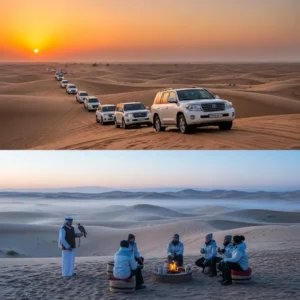
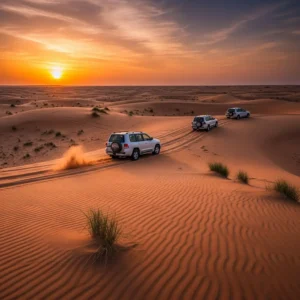
Most tourists hop into a car, scream during the dune bashing, eat dinner, and leave.
They scratch the surface.
But beneath that surface lies a world of wonder.
This world is unlocked only by those who call the desert home.
These guides are not just drivers.
They are trackers.
They are historians.
They are the guardians of the dunes.
In this extensive guide, we are going to shift your perspective.
We will not just tell you what a safari is.
We will show you what a safari means to the people who live it.
We will explore how they navigate without GPS.
We will learn how they read the wind.
We will discover the secret spots that maps don’t show.
When you book with https://royaldesertadventures.ae/, you are booking this expertise.
You are booking a connection to the land.
Let us step into the shoes of the Bedouin descendants.
Let us see the desert for what it truly is.
The Guide: More Than a Driver
In the tourism industry, a driver gets you from A to B.
A local guide takes you on a journey.
The difference is passion.
For a local guide, the desert is their backyard.
They grew up hearing stories about the dunes.
They know the names of the valleys.
They know which dunes are safe and which are treacherous.
When you join a Desert Safari Through the Eyes of Local Desert Guides, you feel this passion.
They don’t just drive; they perform.
They handle the Land Cruiser like an extension of their body.
They anticipate the sand’s movement.
They respect the terrain.
They are proud of their heritage.
They want to show you the beauty they see every day.
This transforms a simple tour into a cultural exchange.
You stop being a tourist.
You become a guest.
Reading the Dunes: The Art of Navigation
Have you ever wondered how they don’t get lost?
The desert has no road signs.
The dunes change shape with every storm.
Yet, a local guide always knows where North is.
They use ancient skills.
They look at the sun.
They look at the shape of the ripples in the sand.
The wind creates a specific pattern on the dunes.
One side is gradual (the windward side).
The other side is steep (the slip face).
By looking at this, they know the prevailing wind direction.
This acts as a natural compass.
They also use landmarks.
To you, it is just another pile of sand.
To them, it is “Big Red” or “The Saddle”.
They memorize the horizon.
During a Desert Safari Through the Eyes of Local Desert Guides, ask them how they know where to go.
They might show you a distant Ghaf tree.
They use these trees as waypoints.
It is a mental map built over years of experience.
It is far more reliable than Google Maps, which often fails in the deep desert.
The Language of Tracks: Wildlife Spotting
You might look out the window and see nothing.
“There are no animals here,” you might think.
Your guide sees a busy highway.
The sand records everything.
Every creature that walks leaves a signature.
A local guide can read these signatures.
They can spot the tiny tracks of a darkling beetle.
They can identify the winding trail of a sand viper.
They can show you where a lizard stopped to sunbathe.
They can distinguish between a fox track and a feral cat track.
This is the magic of a Desert Safari Through the Eyes of Local Desert Guides.
They will stop the car.
They will point to a bush.
“Look,” they will say.
And suddenly, you see a Gazelle frozen in camouflage.
You would have driven right past it.
They know where the Arabian Oryx herds graze.
They know the time of day when they come out.
They turn the empty desert into a safari park.
You just need to know where to look.
The Physics of Sand: Driving with Finesse
Dune bashing is often seen as chaos.
It looks like reckless driving.
But through the eyes of a professional guide, it is physics.
It is fluid dynamics.
Sand acts like a liquid.
A skilled guide knows exactly how the car will react.
They know that momentum is key.
If you stop on an uphill slope, you sink.
If you turn too sharp on a slip face, you roll.
They read the “color” of the sand.
Darker sand might be wet and firm.
Lighter, powdery sand is soft and dangerous.
They adjust their tire pressure precisely.
Not just “deflate tires.”
They know the exact PSI needed for that specific day’s temperature.
In summer, the sand is soft, so they go lower.
In winter, it is firm, so they stay higher.
Watching them drive is like watching a ballet.
They flow over the crests.
They drift down the slopes.
It is controlled aggression.
It is safe because they understand the limits.
This skill only comes from years of practice in the Desert Safari Through the Eyes of Local Desert Guides.
The Ghaf Tree: A Symbol of Life
You will see scraggly trees dotting the landscape.
To a tourist, they are just bushes.
To a local guide, the Ghaf tree is sacred.
It is the national tree of the UAE.
It is the “Tree of Life”.
Your guide will tell you why.
Its roots go down 30 meters to find water.
It never dies, even in the harshest summer.
In the past, it provided shade for the Bedouins.
It provided food for their camels.
It provided wood for their fires (only dead branches were taken).
It provided medicine from its leaves.
It was a meeting point.
Tribes would agree to meet “under the big Ghaf tree in the west”.
During your safari with https://royaldesertadventures.ae/, stop by a Ghaf tree.
Touch its bark.
Listen to the guide’s story.
You will realize that this tree is a hero of survival.
It changes your respect for the environment.
Water: The Hidden Treasure
Water is life.
In the city, we turn a tap and water flows.
In the desert, water is hidden.
A local guide knows where to look.
They know the ancient wells.
Some are hundreds of years old.
They are hidden in wadis (valleys).
They know the signs of underground water.
Certain plants only grow where the water table is high.
If you see a cluster of green, there is water below.
Bedouins had a mental map of every water source in the emirate.
Your guide carries this knowledge.
They might take you to an old well.
They will show you how they drew water with leather buckets.
It is a humbling lesson.
It teaches us not to waste.
It is a core part of the Desert Safari Through the Eyes of Local Desert Guides.
The Falcon: A Partner, Not a Pet
You will see falcons at the camp.
Tourists take photos with them.
But ask your guide about the bird.
To a local, a falcon is a partner.
It is a hunting companion.
In the past, they did not keep falcons in cages.
They trapped them during migration.
They trained them to hunt for the family.
The falcon caught meat (hares and birds).
The Bedouin shared the meat with the falcon.
At the end of the season, they released the bird.
They let it go back to the wild to breed.
This relationship was based on mutual respect.
It was sustainable.
Your guide can explain the training process.
“Manalah” is the process of gaining the bird’s trust.
It involves staying awake with the bird for days.
It creates a deep bond.
When you hold the falcon, remember this history.
It is not a circus animal.
It is a warrior of the sky.
Coffee: The Language of Hospitality
You arrive at the camp.
You are offered coffee.
You drink it and move on.
But wait.
Ask your guide about the coffee (Gahwa).
To a local, coffee is a language.
The way it is poured sends a message.
The host holds the pot (Dallah) in the left hand.
They serve with the right hand.
They pour only a small amount in the bottom of the cup.
Why?
Because they want to serve you hot coffee many times.
If they fill the cup, it gets cold.
It also means “I want you to leave soon.”
A small pour means “Stay, relax, let me serve you again.”
It is a sign of respect.
Shaking the cup means “I am finished.”
Covering the cup with your hand means “No more.”
These subtle signals are part of the Desert Safari Through the Eyes of Local Desert Guides.
Understanding them makes you an insider.
It shows you respect the culture.
The Winds: Shamal and Kous
The wind shapes the desert.
Locals have names for the wind.
The “Shamal” is the north wind.
It brings dust and sandstorms.
It reshapes the dunes.
The “Kous” is the south wind.
It brings humidity from the ocean.
A guide reads the wind like a weather forecast.
They know if a storm is coming hours before it hits.
They know where to camp to avoid the sand blowing in your face.
They park the car with the rear into the wind to protect the engine.
They set up the tents in the lee of the dune.
This practical knowledge ensures your comfort.
A tourist might set up a tent anywhere.
A local sets it up in the perfect spot.
This expertise is why you book with professionals like https://dubaidesertsafarie.com/.
Hidden Locations: Beyond the Tourist Trap
The main safari routes are crowded.
Everyone goes to the same dunes.
A local guide knows the secret spots.
They know “Pink Rock”.
They know “Fossil Rock”.
They know the hidden valleys where no one goes.
If you book a private tour, they can take you there.
These spots are pristine.
There are no tire tracks.
There is no litter.
It is just you and the silence.
This is the true luxury of the Desert Safari Through the Eyes of Local Desert Guides.
It is the luxury of isolation.
It feels like you are the first person to explore this land.
Ask your guide to take you “off-piste”.
They will light up.
They love showing off their secret places.
The Stars: The Ancient GPS
At night, the desert is dark.
Locals used the stars to navigate.
They didn’t just look at the moon.
They knew the constellations.
They knew that “Suhail” (Canopus) marks the end of summer.
When Suhail rises, the heat breaks.
They knew the North Star led them home.
During an overnight safari, ask your guide about the stars.
They might not know the Greek names (Orion, etc.).
But they know the Bedouin names.
They can tell you stories about the stars.
Legends of love and war written in the sky.
It connects the landscape below to the heavens above.
It is a magical part of the Desert Safari Through the Eyes of Local Desert Guides.
Food: Eating Like a Bedouin
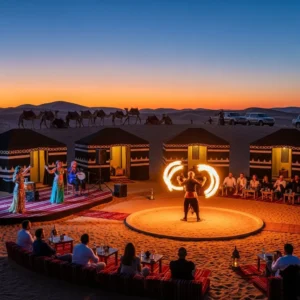
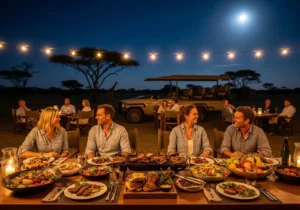
The buffet at the camp is international.
It has pasta and coleslaw.
That is not desert food.
A local guide will tell you what they really eat.
They eat dates.
Dates are the superfood of the desert.
They last for years.
They provide energy.
They drink camel milk.
It is rich and salty.
They eat “Harees”.
This is a porridge of wheat and meat.
It is slow-cooked in the sand.
They bake bread (“Arboth”) directly on the coals.
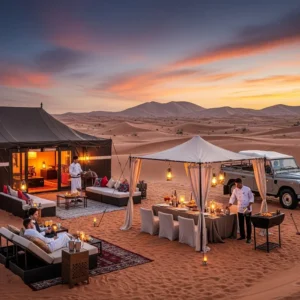
If you are lucky, on a private safari, your guide might cook for you.
They might make fresh bread on a fire.
They might brew fresh tea with desert herbs.
This taste is authentic.
It is smoky and real.
It is far better than the buffet line.
Check authentic food options at https://hafiztourism.com/.
The Seasonal Rhythm
The desert changes with the seasons.
A tourist thinks it is always hot.
A local knows better.
Winter is the time for camping.
It is the time for hunting.
The desert turns green after the rain.
Truffles grow under the sand.
Yes, desert truffles!
Locals go out to hunt for them.
Summer is the time for the “Liwa” dates harvest.
It is the time to stay near the oasis.
Spring is the breeding season for animals.
A Desert Safari Through the Eyes of Local Desert Guides changes with the calendar.
Your guide will tell you what is happening in nature right now.
“Look, the Ghaf is flowering.”
“Look, the lizards are hibernating.”
This context makes the trip richer.
Safety: The Sixth Sense
The desert can be dangerous.
Cars can roll.
People can get lost.
Heatstroke can kill.
A local guide has a sixth sense for danger.
They know when a guest is dehydrated before the guest knows.
They know when a dune is too soft to climb.
They know when a car sounds wrong.
They carry recovery gear.
They carry extra water.
They never panic.
If a car gets stuck, they laugh.
They know exactly how to get it out in 5 minutes.
This confidence makes you feel safe.
You know you are in good hands.
Safety is the priority at https://royaldesertadventures.ae/.
Sustainability: Protecting the Home
This is their home.
They don’t want it destroyed.
A good local guide is an environmentalist.
They pick up trash that others leave behind.
They don’t chase the animals with the car.
They drive on established tracks to protect the vegetation.
They teach you to respect the desert.
“Take only photos, leave only footprints.”
This is not a slogan for them.
It is a way of life.
By choosing a respectful tour, you support this preservation.
You help keep the desert wild.
This ethical approach is central to the Desert Safari Through the Eyes of Local Desert Guides.
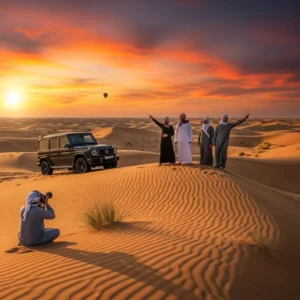
Photography: The Guide’s Angle
You want the perfect Instagram shot.
Your guide knows where it is.
They know where the sun sets relative to the dune.
They know how to create a silhouette.
They know how to make the sand look endless.
They have taken thousands of photos for tourists.
Hand them your phone.
They will direct you.
“Stand here.”
“Look there.”
“Throw the sand.”
They know the tricks.
They know how to capture the “Golden Hour”.
Trust their eye.
They see the beauty every day.
The Spiritual Connection
For many locals, the desert is a place of prayer.
It is clean.
It is quiet.
It brings you closer to God.
You might see your guide stop to pray at sunset.
Respect this moment.
Watch the peace on their face.
It adds a spiritual dimension to the trip.
It reminds you that this is not just a playground.
It is a holy place for many.
It invites you to reflect on your own life.
To find your own silence.
This spiritual aspect is the deepest layer of the Desert Safari Through the Eyes of Local Desert Guides.
Conclusion
A desert safari can be a tourist trap.
Or it can be a life-changing experience.
The difference lies in the guide.
Seeing the Desert Safari Through the Eyes of Local Desert Guides opens a door.
It invites you into a world of history, skill, and beauty.
You stop seeing sand.
You start seeing stories.
You stop seeing a wasteland.
You start seeing a home.
So, when you book your trip, choose carefully.
Choose an operator that values its guides.
Choose an operator that respects the heritage.
Ask questions.
Listen to the answers.
Let the guide show you their world.
Visit https://royaldesertadventures.ae/ to meet our experts.
Book your cultural journey at https://dubaidesertsafarie.com/ and https://hafiztourism.com/.
The desert is waiting to speak to you.
You just need someone to translate.
See you in the sands.
Guide’s Secret Vocabulary
| Word | Meaning | Context |
| Ghaf | National Tree | The survivor of the desert |
| Gahwa | Coffee | Symbol of welcome |
| Sabkha | Salt Flat | Dangerous, slippery terrain |
| Barchan | Crescent Dune | Moved by wind |
| Wadi | Valley | Dry riverbed |
| Shamal | North Wind | Brings dust storms |
| Bedouin | Desert Dweller | The original locals |
20 FAQs with Long Answers
1. How experienced are the local guides?
The guides employed by reputable companies like https://royaldesertadventures.ae/ are highly experienced. Many have grown up in or near the desert regions. They undergo rigorous training not just in driving, but in first aid, customer service, and cultural history. Most have logged thousands of hours driving in the dunes. They are licensed by the Dubai government (DTCM) which requires passing strict tests. You are in the hands of professionals who know the terrain intimately.
2. Can the guides speak English?
Yes, all licensed safari guides in Dubai speak fluent English. It is the primary language of tourism in the UAE. Many guides also speak other languages such as Arabic, Hindi, Urdu, Russian, German, or French. If you have a specific language requirement, you can request it at the time of booking, and the operator will do their best to assign a guide who speaks your native tongue.
3. Do the guides actually live in the desert?
While most modern guides live in the city of Dubai or nearby towns, many come from families with Bedouin roots or from rural areas where desert life is part of their heritage. They spend more time in the desert than they do in the city. Their connection to the land is cultural and professional. They maintain the traditions of their ancestors even if they sleep in a modern apartment at night.
4. Will the guide teach us about the history?
Yes, a good guide loves to share history. During the drive to the desert (which takes about 45 minutes), they will explain the transformation of Dubai from a fishing village to a metropolis. Once in the desert, they will explain Bedouin survival skills, the importance of camels, and the history of the trade routes. Desert Safari Through the Eyes of Local Desert Guides is an educational journey, not just a thrill ride.
5. Can I ask the guide to stop for photos?
Absolutely. In a private safari, you can stop whenever you want. In a shared safari, the guide has specific photo stops planned at the most scenic high dunes. However, if you see something amazing, ask politely. If it is safe to stop, they usually will. They know the best angles and are often happy to take photos of you with your camera.
6. Do the guides know where the animals are?
Yes, they track the animals daily. They know the territories of the Arabian Oryx and the Gazelles. They know that animals are more active in the early morning or late afternoon. While wildlife sightings are never guaranteed (it’s nature, not a zoo), a local guide significantly increases your chances because they are constantly scanning the horizon for movement that a tourist would miss.
7. Is it safe to trust the guide’s driving?
Yes. It might feel chaotic and dangerous to you, but the guide is in total control. They are trained to drive in a way that maximizes thrills while maintaining safety. They know the limits of the vehicle. They know how to read the sand conditions. The roll cages and safety belts are there as a precaution, but the driver’s skill is your primary safety feature. Trust them; they do this every day.
8. Do guides expect tips?
Tipping is not mandatory, but it is highly appreciated. It is a way to say “thank you” for their skill and hospitality. If you felt the guide added value to your experience—by driving safely, sharing stories, taking photos, and being friendly—a tip is appropriate. A standard amount is 20-50 AED per person, or 100 AED per car, but give whatever you feel is deserved.
9. Can the guide help if I get motion sickness?
Yes. They are trained to handle this common issue. If you tell them you are feeling unwell, they will stop the car immediately. They will let you get fresh air. They can also adjust their driving style to be smoother and less aggressive for the rest of the trip. They carry water and sometimes mints or bags. Don’t be afraid to speak up; they want you to enjoy the trip, not suffer.
10. Do guides know first aid?
Yes, it is a requirement for their license. All safari guides must complete first aid and CPR training. The vehicles are equipped with first aid kits. In the event of a medical emergency, they know the evacuation protocols and the quickest routes to the nearest main road to meet an ambulance. Safety is the backbone of the Desert Safari Through the Eyes of Local Desert Guides.
11. Can the guide show us hidden spots?
If you book a private tour, yes. On a standard shared tour, the route is usually fixed to keep the convoy together. But on a private tour, you can ask the guide to take you away from the crowds. They know valleys and peaks that the big buses can’t reach. They can take you to Fossil Rock or Pink Rock if it’s part of the customized itinerary.
12. How do guides navigate without GPS?
While they do have GPS for emergencies, they rarely use it for navigation. They use visual landmarks—a specific shape of a dune, a fence line, a Ghaf tree, or a distant mountain. They use the sun and the wind direction. They have a mental map of the desert that is far more detailed than any digital map. It is an intuitive skill built over years.
13. Will the guide eat dinner with us?
In most standard safaris, the guides eat separately or in a designated area for staff. However, if you bond with your guide and invite them to join you, they might accept, or they might politely decline to let you enjoy your privacy. In private safaris, the dynamic is more personal, and you might share coffee or snacks together during the stops.
14. Can the guide help with the headscarf?
Yes, this is a classic guide service. If you buy a Ghutra (headscarf), the guide will show you how to tie it in the traditional Emirati style. There are different styles (Cobra, Butterfly, etc.). It is a fun cultural interaction and looks great in photos. They are experts at tying it securely so it doesn’t fly off in the wind.
15. Do guides care about the environment?
Professional guides from reputable companies are trained in sustainability. They are taught to respect the desert. They will not throw trash. They will pick up trash if they see it. They will not chase animals. They will drive on tracks where possible to protect vegetation. They are the stewards of the desert and want to keep it beautiful for future guests.
16. What is the hardest part of being a guide?
The hardest part is maintaining high energy and focus in the extreme heat of summer. Driving in the dunes requires intense concentration. Doing this twice a day in 45-degree heat is physically draining. Yet, they greet every guest with a smile. They are resilient, just like the Bedouins of the past.
17. Can I request a female guide?
Female safari guides exist but are rare in the industry. It is a male-dominated profession. However, some companies are starting to train female drivers. If this is a strict requirement for you (for cultural or personal reasons), you must contact the operator like https://dubaidesertsafarie.com/ well in advance to check availability. It cannot be guaranteed on a standard booking.
18. Do guides drive the same route every day?
Not exactly. The desert changes every day. The wind moves the dunes. A track that was there yesterday might be gone today. A dune that was smooth might now have a sharp drop-off. The guide has to “read” the road anew every single trip. They might have a general direction, but the specific line they take changes constantly. This keeps it exciting for them too.
19. How can I become a desert guide?
It takes a lot of training. You need a driving license, then a special desert driving license. You need to pass police tests. You need first aid certification. You need customer service training. You need to work as a trainee driver, following a lead car for months, before you are allowed to drive guests. It is a skilled profession, not a casual job.
20. Why book with Royal Desert Adventures?
We select our guides based on personality and skill. We don’t just want drivers; we want ambassadors. Our guides are passionate about the UAE. They are paid well and treated well, which means they treat you well. We invest in their training. When you book with us, you get a friend in the desert, not just a chauffeur. This is the essence of the Desert Safari Through the Eyes of Local Desert Guides.