

Dubai Desert Photography 15 Epic Secrets for Viral Instagram Shots
The world lives on social media.
We scroll through endless feeds.
We see beautiful places.
But few places stop the scroll like Dubai.
Specifically, the golden sands of the UAE.
Dubai Desert Photography has become a global phenomenon.
It is not just for professionals anymore.
It is for everyone with a smartphone.
The contrast of the blue sky and red sand is perfect.
The light is soft and flattering.
But getting that perfect shot requires skill.
It requires planning.
You cannot just point and shoot.
You need to know where to go.
You need to know when to go.
This guide is your bible for desert content.
We will explore the best locations.
We will discuss lighting techniques.
We will talk about outfits and poses.
If you book with https://royaldesertadventures.ae/, you get expert drivers.
They know the dunes better than anyone.
They know exactly where the sun hits the sand.
Let us dive into the art of capturing the desert.
Why Dubai Desert Photography is Unique
Deserts exist all over the world.
So why is Dubai special?
The sand here has a unique color.
In areas like Al Lahbab, it is deep red.
This color pops on camera.
It creates a rich, warm tone in photos.
The texture of the sand is also distinct.
The winds create ripples.
These ripples act as “leading lines” in photography.
They draw the viewer’s eye into the picture.
Dubai Desert Photography is also about accessibility.
You are only 45 minutes from a modern city.
You can shoot high-fashion looks in the wild.
Then you can be back in a hotel for dinner.
This mix of rugged nature and luxury convenience is rare.
The Magic of the Golden Hour
Lighting is everything.
You can have the best camera in the world.
But if the light is bad, the photo is bad.
In the desert, midday sun is harsh.
It creates ugly shadows under your eyes.
It makes the sand look flat and white.
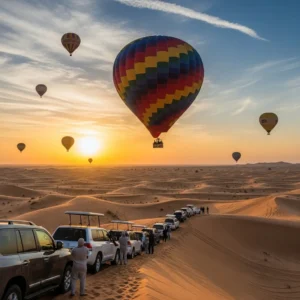
The secret to Dubai Desert Photography is the Golden Hour.
This is the hour just after sunrise.
Or the hour just before sunset.
The sun is low on the horizon.
The light is soft and gold.
It makes your skin glow.
It creates long, dramatic shadows on the dunes.
This adds depth to your images.
Never book a photo tour for 12:00 PM.
Always aim for 4:00 PM onwards in winter.
Or 5:30 AM for the morning light.
Choosing the Right Gear
Do you need a DSLR?
Not necessarily.
Modern phones are incredible.
The iPhone and Samsung Galaxy take amazing photos.
However, for Dubai Desert Photography, a real camera helps.
A DSLR or Mirrorless camera gives you control.
You can shoot in RAW format.
This allows for better editing later.
If you use a lens, go wide.
A wide-angle lens captures the vastness.
It makes the dunes look bigger.
It makes the sky look endless.
A telephoto lens is also good.
It compresses the background.
It makes the sun look massive behind a silhouette.
Protect your gear.
Sand is the enemy of electronics.
One grain of sand can ruin a lens.
Keep your camera in a bag when not shooting.
Use a UV filter to protect the glass.
Don’t change lenses in the wind.
Top Spot 1: The Red Dunes of Al Lahbab
If you want the classic red sand shot.
You must go to Al Lahbab.
This is the most popular spot for Dubai Desert Photography.
The dunes here are high.
Some are 30 meters tall.
They offer a clean background.
You can stand on a peak.
Behind you, there is nothing but sand.
No power lines.
No roads.
Just pure nature.
This is where the “flying dress” photos happen.
The wind here is constant.
It blows the fabric beautifully.
https://royaldesertadventures.ae/ specializes in tours to this specific area.
Top Spot 2: Fossil Rock
This is for a different vibe.
Fossil Rock is in Sharjah, near Dubai.
It offers a mix of sand and jagged rocks.
The rocks are millions of years old.
They have marine fossils in them.
For Dubai Desert Photography, this adds texture.
You can sit on a rocky outcrop.
You have the dunes in the background.
It looks rugged and adventurous.
It is perfect for lifestyle brands.
It is great for car photography too.
The terrain is harder here.
Top Spot 3: Al Qudra Love Lakes
This is a man-made wonder.
It is a series of lakes in the desert.
They are shaped like two hearts.
From the ground, it looks like an oasis.
There are trees and birds.
There are swans and flamingos.
This adds life to your Dubai Desert Photography.
It is not just dead sand.
It is green and blue.
Sunset here is spectacular.
The reflection of the sun in the water is key.
You can get mirror shots.
It is very popular for couples.
It is a romantic setting.
Top Spot 4: The Ghost Village (Al Madam)
Do you want something spooky?
Al Madam is an abandoned village.
The sand has reclaimed the houses.
You can see rooms half-filled with sand.
Doors are open to the dunes.
It is surreal.
It creates a moody atmosphere.
For editorial Dubai Desert Photography, this is gold.
It tells a story of nature winning.
It is a bit further away.
But it is worth the drive.
The light coming through the windows is dramatic.
Top Spot 5: Dubai Desert Conservation Reserve
This is for wildlife lovers.
You cannot just drive here.
You need a special operator.
The reserve is protected.
Here you find the Arabian Oryx.
You find the Gazelles.
Dubai Desert Photography is not just about people.
It is about the animals too.
Photographing a white Oryx is a challenge.
You need a zoom lens.
They are shy.
But the backdrop is pristine.
There are no tire tracks here.
The sand is untouched.
Composition Technique: Leading Lines
How do you frame the shot?
Look at the ripples in the sand.
They are lines created by the wind.
Use them.
Position your camera low.
Let the lines lead to the subject.
This creates a journey for the eye.
It makes the photo feel 3D.
Dubai Desert Photography relies on these natural patterns.
Don’t just stand at eye level.
Crouch down.
Get close to the ground.
The foreground is important.
Composition Technique: Scale
The desert is huge.
You are small.
Show this contrast.
Walk far away from the camera.
Stand on a high dune ridge.
Let the photographer shoot from another ridge.
You will look like a tiny silhouette.
This shows the grandeur of the location.
It creates a sense of wanderlust.
It makes the viewer feel the isolation.
In Dubai Desert Photography, negative space is good.
Let the sky take up 70% of the frame.
It feels open and free.
The Art of the Silhouette
Sunsets are for silhouettes.
When the sun is low, stand in front of it.
Your body becomes a black shape.
Focus on the outline.
Wear clothes that have a shape.
A hat looks great in silhouette.
A flowing dress looks great.
Jump in the air.
Capture the motion.
Dubai Desert Photography silhouettes are iconic.
They are emotive.
They don’t show facial expressions.
They show feeling through body language.
Outfit Guide for the Desert
What should you wear?
Color is crucial.
Don’t wear beige.
You will disappear into the sand.
Wear contrasting colors.
White is angelic and clean.
Red is bold and dramatic.
Black is moody and sharp.
Blue contrasts with the orange sand.
For Dubai Desert Photography, flow is important.
Stiff clothes look awkward.
Wear fabrics that move with the wind.
Chiffon or silk works well.
For men, a white linen shirt is classic.
Or a traditional Kandura.
It adds cultural context to the shot.
Posing Tips for Non-Models
You are not a professional model.
That is okay.
The desert makes you look good.
Don’t just stand straight.
Create triangles with your limbs.
Put a hand on your hip.
Bend one knee.
Look away from the camera.
Look at the horizon.
This looks candid.
It looks like a moment caught in time.
Interact with the environment.
Pick up some sand.
Let it fall through your fingers.
Dubai Desert Photography is about action.
Walk away from the camera.
Turn your head back slightly.
It is the classic “follow me” shot.
Action Photography: Dune Bashing
You want to capture the thrill.
Photographing moving cars is hard.
You need a fast shutter speed.
At least 1/1000 of a second.
Stand at the bottom of a dune.
(Stay safe distance away).
Shoot the car coming down.
Capture the sand spraying up.
This spray is called a “rooster tail”.
It looks dynamic.
It shows the power of the car.
Dubai Desert Photography includes these action shots.
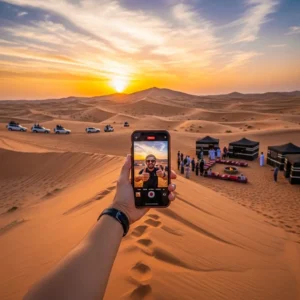
Use “burst mode” on your phone.
Take 10 photos in a second.
Pick the best one later.
Sandboarding Shots
Sandboarding is fun to shoot.
Get low to the ground.
Shoot the board coming towards you.
Or shoot from the side.
Capture the expression on the rider’s face.
Are they laughing?
Are they screaming?
If they fall, keep shooting.
The fall is often the best photo.
It is authentic.
It shows the fun.
Dubai Desert Photography should be fun.
It shouldn’t be too serious.
Wildlife Photography Patience
Animals don’t pose.
You have to wait.
If you see an Oryx, stop the car.
Turn off the engine.
Wait for them to relax.
They might look at you.
That is the shot.
Focus on the eyes.
If the eyes are sharp, the photo works.
Don’t make noise.
Don’t chase them.
Use a zoom lens.
Dubai Desert Photography respects nature.
A photo is not worth stressing the animal.
Astro-Photography: Shooting the Stars
The desert night is dark.
This is perfect for stars.
You need a tripod.
You cannot hold the camera.
Set a long exposure.
Maybe 20 or 30 seconds.
Open the aperture wide (f/2.8).
Increase the ISO (1600 or 3200).
You will see thousands of stars.
You might see the Milky Way.
Include a tent or a car in the foreground.
Light paint it with a torch.
This gives the photo context.
Dubai Desert Photography at night is magical.
It requires practice.
But the results are stunning.
Choosing the Right Operator
Not all safaris are photo-friendly.
Group tours rush you.
They give you 10 minutes at sunset.
That is not enough.
You need time to set up.
You need time to change outfits.
Book a private tour.
https://royaldesertadventures.ae/ offers private cars.
You tell the driver “stop here”.
You tell the driver “wait for the light”.
They understand photographers.
They are patient.
They act as assistants.
This makes a huge difference.
Post-Processing Secrets
Taking the photo is half the work.
Editing is the other half.
For Dubai Desert Photography, presets help.
Use warm presets.
Boost the orange and yellow saturation.
Don’t overdo it.
Keep the sky blue, not teal.
Add some contrast.
Increase the clarity to show the sand texture.
Apps like Lightroom Mobile are great.
Snapseed is also powerful.
Remove footprints if necessary.
You want the sand to look untouched.
Cultural Respect and Rules
Dubai has strict privacy laws.
You cannot photograph people without permission.
Especially local women.
Always ask before shooting.
Respect the culture.
Don’t wear inappropriate clothing.
Swimwear is for the beach, not the desert.
Dress modestly but stylishly.
Dubai Desert Photography must be respectful.
Don’t take photos of government buildings.
Don’t take photos of military areas.
Stick to the scenery and your group.
Drone Photography Regulations
Drones take epic photos.
But Dubai has strict drone laws.
You need a license to fly.
You cannot fly near airports.
You cannot fly over people.
In the desert, it is easier.
But you still need the permit.
If you fly illegally, you face fines.
Your drone will be confiscated.
It is better to hire a licensed operator.
Some tour companies have drone pilots.
They can film you from the sky.
This is the safest way to get aerial Dubai Desert Photography.
Protecting Your Gear from Sand
We mentioned this before.
But it is vital.
Sand gets everywhere.
It gets in the charging port.
It gets in the buttons.
Use a blower to clean your camera.
Do not wipe the lens with a cloth if there is sand.
It will scratch the glass.
Blow the sand off first.
Use a plastic bag to cover the camera if it is windy.
For Dubai Desert Photography, be paranoid about sand.
Check your gear every night.
Clean it thoroughly.
Seasonal Guide for Light
The light changes with seasons.
In winter, the sun is lower.
The shadows are longer all day.
The light is softer.
This is the best season for Dubai Desert Photography.
In summer, the sun is high.
It is overhead at noon.
The shadows disappear.
The light is white and harsh.
You have to shoot very early or very late.
The golden hour is shorter in summer.
You have to work fast.
Humidity can also cause haze in summer.
Winter brings crystal clear skies.
Cost vs Value of Photo Tours
A dedicated photo tour costs more.
You pay for the private car.
You pay for the extra time.
Is it worth it?
If you want content, yes.
One viral photo can grow your account.
One amazing memory is priceless.
A standard safari is for the experience.
A Dubai Desert Photography tour is for the art.
You are paying for the freedom to create.
Don’t cheap out on the vehicle.
You want a clean, nice looking car for photos too.
A luxury Land Cruiser looks better in shots than a bus.
The Flying Dress Photoshoot Trend
You have seen it.
A woman in a 5-meter long dress.
Standing on a dune.
The dress flying in the wind.
This is a specific service.
You can rent these dresses.
They come in red, blue, yellow.
Photographers specialize in this.
They know how to throw the dress.
They capture the movement.
It is very dramatic.
It is the ultimate Dubai Desert Photography souvenir.
It costs extra.
But the result is magazine quality.
Comparison: Standard Safari vs Photo Tour
Let’s compare.
Standard Safari:
-
Shared car.
-
Fixed schedule.
-
15 mins for sunset.
-
Crowded spots.
-
Driver rushes you.
Photo Tour:
-
Private car.
-
Flexible schedule.
-
1 hour for sunset.
-
Secluded spots.
-
Driver assists you.
The choice is clear.
If you care about photos, go private.
Check options at https://dubaidesertsafarie.com/.
Why Choose Royal Desert Adventures?
We understand creators.
We know you need time.
We know you need specific angles.
Our drivers are trained to spot photo ops.
They are happy to help.
https://royaldesertadventures.ae/ offers bespoke packages.
We can take you to hidden dunes.
We can arrange the flying dress.
We can bring a camel just for you.
We make your Dubai Desert Photography vision a reality.
We don’t rush the sunset.
We let you enjoy the moment.
Conclusion
The desert is a canvas.
You are the artist.
Your camera is the brush.
Dubai Desert Photography is an adventure.
It is about chasing the light.
It is about finding beauty in emptiness.
With the right preparation, you can capture magic.
You can take photos that amaze your friends.
You can create art that lasts forever.
Don’t settle for mediocre snapshots.
Plan your shoot.
Book the right car.
Wake up for the sunrise.
Put in the effort.
The desert rewards patience.
The desert rewards creativity.
So charge your batteries.
Clear your memory cards.
Get ready to shoot.
Visit https://royaldesertadventures.ae/ to book your photo tour.
Explore packages at https://dubaidesertsafarie.com/ and https://hafiztourism.com/.
Your masterpiece is waiting in the dunes.
Go and capture it.
Comparison Table: Standard vs Photography Safari
| Feature | Standard Safari | Photography Safari |
| Transport | Shared Land Cruiser | Private Land Cruiser |
| Timing | Fixed Schedule | Flexible for Light |
| Sunset Stop | 10-15 Minutes | 45-60 Minutes |
| Locations | Crowded Public Dunes | Secluded/Virgin Dunes |
| Driver Role | Transport Only | Assistant/Spotter |
| Crowds | High | Zero / Low |
| Pace | Fast / Rushed | Slow / Relaxed |
| Equipment | Bring Your Own | Space for Tripods/Bags |
20 FAQs with Long Answers
1. What is the best time of day for Dubai Desert Photography?
The absolute best time for Dubai Desert Photography is during the “Golden Hour.” This occurs twice a day: usually the first hour after sunrise and the last hour before sunset. During these times, the sun is low on the horizon, creating soft, diffused light that is flattering for portraits and brings out the rich red colors of the sand. It also casts long, dramatic shadows that add depth and texture to landscape shots. Midday light (11 AM to 2 PM) is generally too harsh and flat for good photos.
2. Can I take good photos with just a smartphone?
Yes, absolutely. Modern smartphones like the iPhone 15 Pro or Samsung S24 Ultra have incredible cameras that are perfect for Dubai Desert Photography. They have built-in HDR to handle the bright sky and dark sand. The “Portrait Mode” is great for blurring the background. You can also use the wide-angle lens to capture the vastness of the dunes. Just make sure to tap the screen to focus and adjust the exposure (brightness) down slightly to capture the rich colors of the sunset.
3. Do I need a permit to take photos in the desert?
For personal photography, you generally do not need a permit in public desert areas like Al Lahbab or Al Qudra. You are free to take photos for your social media or personal albums. However, if you are doing a commercial shoot with big equipment, lights, and models for a brand, you will need a permit from the Dubai Film and TV Commission. Also, drone photography requires a permit from the GCAA and DCAA, even for hobbyists. Always check the latest regulations.
4. What should I wear for a desert photoshoot?
For the best Dubai Desert Photography results, wear colors that contrast with the environment. The desert is orange/beige. Colors like white, red, emerald green, or royal blue look stunning and pop against the background. Avoid wearing beige, tan, or khaki as you will blend in and look washed out. Flowy fabrics like chiffon dresses look amazing in the wind. For men, white linen shirts or traditional Emirati clothing (Kandura) look very stylish and appropriate.
5. How do I protect my camera from sand?
Sand is very dangerous for cameras. To protect your gear during Dubai Desert Photography, never change lenses out in the open wind. Do it inside the car. Use a UV filter on your lens to protect the glass from scratches. Carry a manual air blower to remove dust; never wipe a sandy lens with a cloth as it acts like sandpaper. When not shooting, keep the camera in a sealed bag. If it’s windy, you can wrap the camera body in a plastic bag, leaving only the lens tip exposed.
6. Can I hire a professional photographer for my safari?
Yes, you can. Many tour operators like https://royaldesertadventures.ae/ can arrange for a professional photographer to accompany you. They will bring high-end equipment, lighting if needed, and guide you on poses. They will then edit the photos and send them to you digitally. This is a popular option for couples, honeymooners, and influencers who want guaranteed high-quality shots without the stress of setting up tripods or asking strangers to take photos.
7. What are the best locations for Instagram photos?
The top locations for Dubai Desert Photography include the Red Dunes of Al Lahbab for that classic high-dune look. The Al Qudra Lakes (Love Lakes) are great for water reflections and greenery. Fossil Rock offers a rugged, rocky texture. The “Ghost Village” of Al Madam offers a unique, moody aesthetic with sand-filled abandoned houses. For wildlife shots, the Dubai Desert Conservation Reserve is the best spot to find Oryx and Gazelles in a pristine setting.
8. How do I get a photo with a falcon?
Most desert safari camps have a falconer stationed near the entrance or in a designated area. You can approach them to take a photo. They will let you wear a protective leather glove and have the falcon perch on your arm. For a more natural shot, you can look for operators that offer “interactive falconry” where you can photograph the bird flying in the open desert during the day, rather than just sitting in the camp at night.
9. Is it safe to go deep into the desert for photos?
It is not safe to go deep into the desert alone if you don’t know the terrain. You can get stuck in soft sand, or get lost. For deep desert Dubai Desert Photography, always hire a professional driver with a 4×4. They know the safe routes and have recovery gear. Stay within sight of the car. Dehydration happens fast, so always carry water. If you want those “remote” looking shots, a driver can take you just a few dunes away from the road where it looks empty but is safe.
10. Can I do a photoshoot with a camel?
Yes, camels are very photogenic. You can take photos during the short camel ride included in most safaris. For a serious photoshoot, you can request a private camel setup. The handlers can make the camel sit down or stand still for you. Be gentle with the animals. Do not use flash directly in their eyes. Stand next to the camel or hold its rein for a classic Bedouin-style portrait.
11. What is the “Flying Dress” photoshoot?
The “Flying Dress” photoshoot is a trend in Dubai Desert Photography. It involves wearing a dress with a very long train (often 3-5 meters). As you stand on a dune, an assistant throws the train into the air, or the wind catches it, creating a dramatic, sweeping effect. It looks like you are flying or floating. You can rent these dresses from specialized rental companies in Dubai, or some tour operators can arrange the full package including the dress and photographer.
12. How do I edit my desert photos?
To get that “Dubai Influencer” look, you usually want to enhance the warm tones. In apps like Lightroom, increase the saturation of oranges and yellows slightly. Lower the highlights to bring back detail in the bright sky. Lift the shadows if the subject is dark. Increase the “clarity” or “texture” slider to make the sand ripples pop. Be careful not to over-saturate the sky; keep the blue looking natural. Vignetting can help focus the eye on the center subject.
13. Can I take photos of the stars?
Yes, the desert is a great place for astrophotography because there is less light pollution than in the city. You will need a camera with manual mode and a sturdy tripod. Set your shutter speed to 20-30 seconds, aperture to the widest setting (like f/2.8), and ISO to 1600 or 3200. Focus manually on a bright star. This will capture the stars clearly. Including a foreground element like a tent or a Ghaf tree makes the photo more interesting.
14. Are drones allowed?
Drones are heavily regulated in the UAE. To fly a drone for Dubai Desert Photography, you must register it with the GCAA. There are many no-fly zones, especially near airports and military bases. Even in the desert, you need to be careful. If you fly without a permit, you risk heavy fines and confiscation of your drone. It is often safer and easier to hire a licensed drone operator if you really want aerial footage.
15. What lens is best for desert landscapes?
A wide-angle lens (like 16mm or 24mm) is excellent for capturing the vast scale of the dunes and the sky. It emphasizes the foreground ripples. However, a telephoto lens (like 70-200mm) is also a secret weapon for Dubai Desert Photography. It compresses the perspective, making the dunes look layered and stacked on top of each other. It also makes the sun look huge in sunset shots. Bringing both gives you the most versatility.
16. How do I deal with the harsh midday sun?
If you are forced to shoot at midday, try to avoid portraits as the shadows will be unflattering. Focus on the landscape textures or high-contrast black and white shots. Use a polarizing filter to cut the glare and deepen the blue sky. You can also use a diffuser (or a white sheet) to soften the light on your subject’s face. Ideally, though, use the midday time for travel or lunch and save the shooting for later in the afternoon.
17. Can I take photos of locals?
You must be very careful and respectful. It is illegal to take photos of people without their consent in the UAE. This is strictly enforced regarding local women. Never take a photo of a local lady without explicit permission (which is rarely granted to strangers). You can ask local men for permission, and they might agree, but always respect a “no”. Focus your Dubai Desert Photography on your own group and the scenery to avoid legal issues.
18. Why should I book a private tour for photography?
A private tour gives you control over time. In a shared group safari, the driver follows a fixed schedule. They might leave the high dunes just as the light is getting perfect because they have to get to the camp for dinner. In a private tour with https://royaldesertadventures.ae/, you can tell the driver, “Wait, the light is perfect,” and stay longer. You can stop at specific spots you like. This flexibility is essential for serious photography.
19. Is there mobile signal in the desert to upload photos?
In most popular desert safari locations like Al Lahbab and near the camps, there is good 4G or 5G mobile signal. You can upload your Dubai Desert Photography to Instagram stories in real-time. However, if you venture deeper into the remote dunes or conservation areas, the signal might become weak or disappear. It is best to save your high-quality uploads for when you are back at the hotel Wi-Fi to save battery and data.
20. How much does a photography tour cost?
A specialized photography tour (private car, extended time) typically costs more than a standard shared safari. You might pay between 800 AED to 1500 AED for the private vehicle, depending on the duration and inclusions. If you hire a professional photographer to come with you, that is an additional cost, often starting from 1000 AED per session. While expensive, splitting the cost among a group of friends makes it reasonable for the quality of content you get.