

Most Beautiful Desert Landscapes: 19 Powerful Secrets to Finding the Ultimate Photo Spot
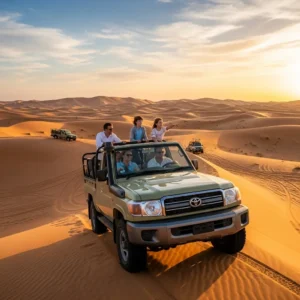
The desert safari is the ultimate visual experience in Dubai. The vast, serene landscape offers boundless photographic potential.
Capturing the Most Beautiful Desert Landscapes requires more than just a standard tourist package. It demands specialization and precise timing.
A professional approach ensures your images transcend the typical snapshot. It turns them into long-lasting memories.
This extensive guide reveals 19 powerful secrets. We detail how to find the Ultimate Photo Locations and master light and composition.
Following these tips ensures your portfolio of Desert Photography is truly spectacular.
1. The Core Secret: Golden Hour Dubai and Light Mastery
Light is the single most critical element in capturing the Most Beautiful Desert Landscapes. Timing the light is everything.
H3: Golden Hour Dubai: The Essential Window
The ‘Golden Hour’ is the optimal time for photography. It occurs just before sunset and shortly after sunrise.
The low angle of the sun casts long, dramatic shadows. This defines the texture and form of the dunes.
This soft, warm light is essential for a high-quality aesthetic.
H3: Exposure Technique for Best Desert Scenery
Use exposure bracketing during the Golden Hour Dubai. This technique captures detail in both the bright sky and the deep shadows.
Combining these exposures in post-processing ensures no part of the Best Desert Scenery is lost.
A correct exposure is the technical foundation of stunning photos.
H4: The Blue Hour Contrast
The “Blue Hour” follows sunset. This cool, deep indigo light is perfect for silhouettes and low-light camp photography.
Utilizing this unique light adds dramatic contrast to the warm desert colors.
2. Location Vetting: Dubai Photo Spot Secrets and Red Dunes
The specific geography dictates the visual quality of the Most Beautiful Desert Landscapes.
H3: Red Dunes Photography: The Crimson Palette
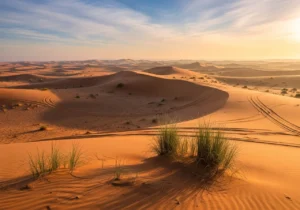
The Red Dunes of Al Badayer are the premier Desert Photography destination. The high iron oxide content creates a vibrant crimson color.
This intense color provides a spectacular, high-saturation backdrop that stands out on social media.
This aesthetic superiority is key to professional Red Dunes Photography.
H3: Dubai Photo Spot Secrets: Pristine Vistas
Pristine Desert Vistas are found on untouched, untracked dunes. Footprints and vehicle tracks compromise the sense of vastness.
Booking a private or specialized tour guarantees access to these clean, pristine slopes.
This ensures your Dubai Photo Spot Secrets remain exclusive.
H4: The Importance of Elevation
Seeking the highest dune crest provides a commanding viewpoint. This allows for grand, sweeping Landscape Photography Dubai.
Elevation helps emphasize the scale of the Ultimate Photo Locations.
3. Equipment and Safety: Safari Photography Gear Protection
Protecting your gear is as important as using it. Sand is the single greatest threat to your camera.
H3: Sand Management and Safari Photography Gear
Carry multiple sealed plastic bags for your camera and lenses. Never change lenses in the open air.
Use a dedicated air blower bulb (not your breath) to remove fine dust particles.
This meticulous care of your Safari Photography Gear is mandatory.
H3: Essential Stabilization
A sturdy tripod is essential for low-light Night Sky Safari Photos and time-lapses.
It ensures the sharpness and stability required for professional Desert Photography.
The tripod also helps with precise composition adjustments.
H4: Lens Selection
A wide-angle lens captures the sheer scale of the Most Beautiful Desert Landscapes.
A telephoto lens is essential for compressing distance and creating powerful silhouette portraits.
4. Composition: Landscape Photography Dubai Mastery
Composition is the artistic secret to great Desert Photography.
H3: Leading Lines and Flow
Use the natural, curving lines of the sand ridges as leading lines. These guide the viewer’s eye through the Desert Landscape Pictures.
Position the subject where the natural lines converge, enhancing the visual interest.
This technique is crucial for professional Landscape Photography Dubai.
H3: Scale and Subject Placement
Include a small subject (a camel, a figure) on the horizon to emphasize the monumental scale of the dunes.
This juxtaposition creates a powerful sense of isolation and grandeur.
This is a signature element of the Ultimate Photo Locations.
H4: Silhouette Perfection
For stunning silhouettes, set your exposure based on the bright sky. This renders the subject as a solid, dark shape.
This classic technique works best during the Red Dunes Photography sunset.
5. Advanced Techniques: Ultimate Photo Locations Hacks
Go beyond the basics to capture truly unique, high-impact Desert Photography.
H3: Time-Lapse and Night Sky Safari Photos
The remote desert, free of city light pollution, is ideal for Night Sky Safari Photos.
Use long exposure and time-lapse techniques to capture the stars’ movement.
This advanced technique yields visually stunning results.
H3: Intentional Motion Blur
Use a slightly slow shutter speed (1/60th or 1/125th) to introduce motion blur to moving subjects like camels or 4x4s.
This adds a dynamic, artistic sense of movement to your Safari Photography Options.
This specialized technique requires practice and a steady hand.
H4: Focus Stacking
For ultra-sharp Desert Landscape Pictures, use focus stacking. This involves merging multiple images focused on different planes.
This ensures every detail, from the near foreground to the distant dune, is perfectly sharp.
6. Booking Strategy: Best Photography Tours and Expert Guide Access
The best photos are taken on tours designed by photographers, for photographers.
H3: Best Photography Tours Selection
Look for operators who offer dedicated Best Photography Tours. These prioritize location and timing over mass market logistics.
This guarantees maximum time during the Golden Hour Dubai window.
Check the expertise of the guide. They should be an Expert Photo Guide.
H3: Vetting the Expert Photo Guide
An Expert Photo Guide knows the best angles, lighting conditions, and composition secrets.
They should assist you with camera settings and positioning.
Their local knowledge of the Desert Photography Hotspots is invaluable.
H4: Private Tour Investment
A private tour (e.g., https://royaldesertadventures.ae/) ensures Exclusive Access to the best Secluded Dune Spots.
This investment guarantees an uninterrupted, personalized Desert Photography experience.
7. Final Vetting: Ultimate Photo Locations Assurance
The final check confirms the operator delivers the promised quality and environment.
H3: Location Guarantee
Ensure the tour guarantees access to the Red Dunes Photography area for superior color and scale.
Vague itineraries should be avoided. Demand confirmation of the specific Ultimate Photo Locations.
H3: Review Confirmation
Check reviews on external platforms (https://dubaidesertsafarie.com/ and https://hafiztourism.com/) for feedback on driver patience and sunset stop duration.
Positive reviews from other photographers confirm the quality of the service.
H4: Safety First
A commitment to Safari Camera Gear safety and overall passenger safety is paramount.
8. Conclusion: Capturing the Best Desert Scenery
Your journey to capturing the Most Beautiful Desert Landscapes is now guided by expert secrets.
Prioritize light, location, and the right Best Photography Tours operator.
The Arabian Desert awaits your lens.
Photography Technical Requirements Table
| Component | Setting/Requirement | Rationale | Focus Keyword Relevance |
| Exposure | RAW Format, Exposure Bracketing | Maximizes recoverable data in highlights/shadows. | Safari Photography Options |
| Stability | Sturdy Tripod | Essential for sharp Low Light Desert Shots and time-lapses. | Night Sky Safari Photos |
| Shutter Speed | 1/1000s or faster | Freezes Action Photo Techniques (sand spray, vehicle). | Action Photo Techniques |
| Color Temp | Warm/Cloudy Preset (Manual WB) | Enhances the reds/oranges of the Golden Hour Dubai. | Golden Hour Dubai |
| Protection | Sealed Bags, Blower Bulb | Shields Safari Camera Gear from highly corrosive fine sand. | Safari Camera Gear |
Frequently Asked Questions (FAQs) – Most Beautiful Desert Landscapes
1. What is the single most important factor for achieving sharp, high-quality Desert Landscape Pictures during the bright desert day?
The single most important factor is using a narrow aperture (f/8 to f/16). This maximizes the depth of field, ensuring that both the near foreground (sand ripples) and the distant background (dune crests) are kept sharp and in focus. This technical precision is vital for capturing vast, detailed Desert Landscape Pictures.
2. How does the Golden Hour Dubai light differ from the Blue Hour light, and which is better for capturing silhouettes?
The Golden Hour Dubai light is warm, soft, and highly directional, ideal for texture and color saturation. The Blue Hour light is cool, ambient, and deep indigo, making it superior for capturing dramatic, clean silhouettes. The blue hour provides a deeper, more uniform background color for the subject to contrast against.
3. Why is a sturdy tripod considered mandatory for any serious Desert Photography session, and what are the primary risks without one?
A tripod is mandatory because Desert Photography requires long exposures for low-light shots (stargazing, camp ambience). Risks without one: Without a tripod, any shutter speed slower than 1/60th of a second will result in motion blur, ruining night sky photos and low-light portraits. The stability is non-negotiable for professional-grade Desert Photography.
4. How can a photographer secure Exclusive Access to pristine, untracked dunes for their photo session, avoiding areas with vehicle marks?
A photographer secures Exclusive Access by booking a private or bespoke photography tour. This allows the operator (like those found via https://royaldesertadventures.ae/) to utilize specialized permits or remote routes, driving far from the main tourist convoys to find Pristine Desert Vistas that have not been marred by footprints or vehicle tracks.
5. What specific techniques should be applied in post-processing to enhance the texture and saturation of the red sand in Red Dunes Photography?
To enhance Red Dunes Photography texture, apply subtle boosts to the Clarity or Texture sliders. To maximize color saturation, focus on boosting the Luminance and Saturation of the orange and red channels in the HSL panel. This intensifies the natural crimson hue of the sand without making the entire image look overly processed.
6. What essential Safari Photography Gear is required to protect expensive camera equipment from sand damage during the high-speed transfer?
Essential Safari Photography Gear includes sealed plastic bags (Ziploc) for storage and a UV filter placed on the lens. The plastic bag protects the camera body and filter from fine, abrasive sand during the high-speed transfer. A dedicated blower bulb is also required for non-contact cleaning of the lens surface.
7. How does including a small human element in Landscape Photography Dubai enhance the final composition and visual impact of the image?
Including a small human element (a person, a camel, or a distant 4×4) in Landscape Photography Dubai enhances the image by providing scale and a focal point. This tiny subject emphasizes the monumental size and vastness of the Most Beautiful Desert Landscapes, drawing the viewer’s eye into the scene and preventing the photo from looking flat.
8. How can a traveler use the external review platform https://dubaidesertsafarie.com/ to vet an operator’s commitment to the Best Photography Tours schedule?
A traveler should use https://dubaidesertsafarie.com/ by filtering reviews for comments on punctuality and time management. Look for explicit praise confirming the guide was patient, allocated enough time (15–20 minutes) at the sunset spot, and ensured the transfer was on time to hit the Golden Hour. This confirms the operator understands the demands of a Best Photography Tours.
9. What unique activities or inclusions should a traveler look for in a package to guarantee a truly high-quality Best Photography Tours experience?
A traveler should look for unique inclusions such as private access to a secluded dune crest, the services of an Expert Photo Guide (not just a driver), the option for a dedicated sunrise shoot, and the inclusion of high-quality props (lanterns, traditional attire) to enhance the visual appeal of the Best Photography Tours.
10. What is the role of the guide, acting as an Expert Photo Guide, in ensuring the final Ultimate Photo Locations composition is successful?
The guide, acting as an Expert Photo Guide, plays a crucial role by managing the logistics and positioning the subject. They drive the 4×4 to the perfect, untracked vantage point, help position the subjects (camels, people) against the sunset, and assist with composition, ensuring the Ultimate Photo Locations are used to their full potential.
11. What is the difference between a high-quality Sunset Photo Locations stop and a crowded, generic stop near the highway?
The difference is exclusivity and background quality. A generic stop is crowded, noisy, and often has vehicle tracks in the background. A high-quality Sunset Photo Locations stop is on a secluded, pristine dune crest deep in the desert, guaranteeing an uninterrupted horizon and a tranquil environment, which is essential for professional-grade photography.
12. How does the position of the sun during the Golden Hour Dubai affect the composition of portraits, and what light should be used to illuminate the subject?
The low, horizontal light of the Golden Hour Dubai creates a beautiful backdrop. For portraits, the sun should be positioned behind the subject (backlighting) to create a glowing rim light effect around their hair and shoulders. A reflector or a gentle flash fill-light should be used to illuminate the face and prevent it from falling into shadow.
13. What ethical rules and Desert Photography Guide tips should be followed when photographing local staff, performers, or other guests at the camp?
The most important rule is to always ask for explicit permission before taking close-up portraits of local staff, performers, or other guests. Follow all directions given by the guide. When filming cultural performances, avoid using harsh, direct flash. This adherence to respect is a core Desert Photography Guide principle.
14. How can a photographer utilize the external link https://hafiztourism.com/ to vet a potential operator’s commitment to providing adequate Red Dunes Photography time?
A photographer should use https://hafiztourism.com/ by filtering reviews for feedback on the specific Al Lahbab location and the patience of the driver. Look for reviews that confirm the operator spent adequate time (at least 20 minutes) at the Red Dunes Photography spot, showing they prioritize the visual schedule over rushing to the camp.
15. What are the legal restrictions and risks associated with bringing and using a drone for aerial Desert Photography in the Dubai area?
Legal restrictions are strict: Drone operation in Dubai requires a permit and official registration (often complex for tourists). Risks: Flying near restricted airspace (airports, military sites) is illegal and can lead to confiscation and heavy fines. Sand and high wind also pose a significant risk of equipment loss, which is why most dedicated Desert Photography Guide tours use professional, licensed pilots.
16. What is the value proposition of a package that includes DSLR Rental Dubai for a traveler who only owns a smartphone?
The value proposition of DSLR Rental Dubai is superior image quality and control. A high-quality DSLR provides better low-light performance, greater dynamic range (essential for sunset contrast), and the ability to use specialized lenses (telephoto/wide-angle). This professional equipment is necessary for capturing truly stunning, high-resolution Desert Landscape Pictures that a smartphone cannot match.
17. How does the choice of footwear affect the photographic outcome and comfort of the Red Dunes Photography session?
The choice of footwear is crucial. Impact: Sturdy, closed-toe shoes are needed for safely climbing the steep Red Dunes Photography crests to reach the best vantage points. Unstable footwear compromises balance and prevents access to the best Sunset Photo Locations. Comfortable shoes allow the photographer to move quickly and efficiently as the light changes.
18. When editing Desert Landscape Pictures, why is it important to use a slight warming filter (adjusting white balance) during post-processing?
It is important to use a slight warming filter because the desert’s natural beauty is associated with warm, vibrant tones. The warmer white balance enhances the gold, orange, and red colors, making the final Desert Landscape Pictures look richer, more inviting, and more cinematic, accurately reflecting the feeling of the Golden Hour Dubai light.
19. How can a traveler utilize the external link https://hafiztourism.com/ to find high-quality Cultural Camp Shots feedback?
A traveler should use https://hafiztourism.com/ to find high-quality Cultural Camp Shots feedback by filtering reviews for comments on the professionalism of the performers and the ambiance of the camp. Look for praise of the “lighting,” “skill of the Tanoura dancer,” or the “quality of the traditional buffet.” These details confirm the camp provides a high-quality setting for Safari Photography Options.
20. What is the Ultimate Photo Locations secret to capturing a perfectly sharp image that includes both the near foreground sand ripples and the distant dune crests?
The Ultimate Photo Locations secret is to use the hyperfocal distance focusing technique. This involves manually focusing the lens approximately one-third of the way into the scene and using a narrow aperture (f/11 or higher). This maximizes the depth of field, ensuring everything from the near foreground sand ripples to the distant dune crests remains perfectly sharp, ideal for Desert Landscape Pictures.