

The Majestic Secrets of Dubai Desert Formations
The desert surrounding Dubai is often seen as a backdrop for adventure sports. However, a deeper look reveals something far more profound.
It is a living museum of geology. It offers breathtaking natural desert beauty.
The key lies in understanding the Dubai Desert Formations.
These are not simply heaps of sand. They are complex structures.
These geological wonders Dubai tell a story of ancient climate shifts.
To truly explore Dubai desert is to appreciate these unique desert landscape features.
This guide reveals the science, beauty, and secrets behind the stunning Dubai Desert Formations.
7 Majestic Secrets Revealed About the UAE’s Unique Desert Landscape
Understanding the seven major types of Dubai Desert Formations elevates any visit. It transforms a trip into an exploration of Arabian desert geology.
The landscape is constantly shaped by wind and time.
These features offer unparalleled opportunities for desert landscape photography.
1. The Dynamic Crescent Dunes (Barchans)
Crescent dunes, or barchans, are the most common of the Dubai Desert Formations.
They are instantly recognizable by their distinct crescent shape.
Their arms, or horns, point downwind, showing the direction of prevailing wind flow.
Barchans are highly mobile desert dune types. They can move several meters per year.
This movement is a dynamic illustration of sand formation viewing in real-time.
They are formed in areas with a consistent wind direction and limited sand supply.
2. The Towering Linear Dunes (Seifs)
Linear dunes, or seifs, stand tall and long. They run parallel to each other.
These Dubai Desert Formations can stretch for tens of kilometers.
They develop where winds shift direction seasonally or semi-regularly.
The long, sharp crest of the seif is a favorite for desert landscape photography.
They are significant features of the unique desert landscape.
3. The Enormous Star Dunes (Pyramidal Forms)
Star dunes are massive, pyramidal Dubai Desert Formations. They are less common but truly majestic.
They are formed when wind blows from multiple directions. This piles sand high in a central point.
These are among the largest desert dune types in the Arabian desert geology.
They symbolize the vast scale and power of the natural desert beauty.
Star dunes offer a supreme sand formation viewing experience.
4. The Ancient Fossil Dunes (Lithified Sands)
Fossil dunes are unique Dubai Desert Formations. They are not made of loose sand.
These ancient structures have been lithified, or turned into soft rock, over millennia.
They represent sand from previous, different climatic eras.
These geological wonders Dubai are invaluable for scientific research.
They are a tangible link to the deeper history of the explore Dubai desert region.
These stunning natural desert beauty structures are found in protected areas.
5. The Interduneal Flats (Ghada and Acacia Habitats)
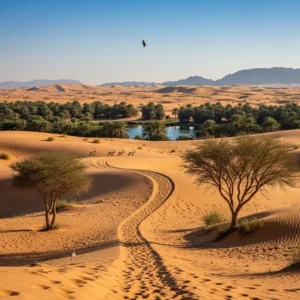
Not all of the unique desert landscape is dunes. The flats between them are equally important.
These interduneal areas are home to resilient desert flora.
Trees like the Ghada and Acacia thrive here, offering shade and sustenance.
These flats are essential to the ecology of the Dubai Desert Formations.
They are critical areas for wildlife spotting when you explore Dubai desert.
6. The Salt Flats (Sabkhas)
Sabkhas are low-lying coastal or inland salt flats. They are a distinctive type of Dubai Desert Formations.
They are formed by the evaporation of saline groundwater near the surface.
A crust of salt forms, sometimes strong enough to walk on, but often treacherous.
These geological wonders Dubai are characterized by their brilliant white appearance.
They showcase a different type of natural desert beauty, dominated by minerals.
7. The Rock Outcroppings and Wadis
While Dubai is mostly sand, the edges feature older rock formations.
Wadis, or dry riverbeds, show evidence of ancient water flow through the Arabian desert geology.
These rocky areas provide shelter and unique habitats.
They remind us that the Dubai Desert Formations were not always solely dry.
The contrasts in texture are excellent for desert landscape photography.
Understanding the Forces Shaping Dubai Desert Formations
The continuous shaping of the unique desert landscape is a result of powerful, natural forces.
The Role of Wind (Eolian Processes)
Wind is the master sculptor of the Dubai Desert Formations.
It moves sand by three primary methods: creep, saltation, and suspension.
Saltation, where sand hops across the surface, is the most effective.
The prevailing wind direction dictates the form of the desert dune types.
Monitoring wind patterns is crucial for sand formation viewing predictability.
The Influence of Water (Fluvial Processes)
Although rare, rainfall has a dramatic effect on the Dubai Desert Formations.
Flash floods create temporary wadis. They move vast amounts of sediment quickly.
Water also contributes to the formation of the sabkhas.
This shows that the natural desert beauty is shaped by extremes.
Geological Time and Sediment Source
The sand itself originated from older rocks, mainly quartz and carbonate material.
The vast quantities come from the erosion of inland mountains and plateaus.
Geological wonders Dubai are products of millions of years of patient erosion.
The color and texture of the Dubai Desert Formations reflect their source.
The Cultural Significance of Dubai Desert Formations
The Beduin people lived harmoniously with the unique desert landscape. Their knowledge is deep.
Navigation by Dunes
The Beduin were expert navigators. They used the desert dune types as landmarks.
The orientation of the linear and star dunes provided fixed reference points.
Their traditional life was entirely dependent on understanding the Dubai Desert Formations.
Water Sourcing in Interduneal Flats
Knowledge of the interduneal flats was vital for survival.
They knew where groundwater was likely to collect.
Finding these shallow aquifers was the difference between life and death.
This human history adds another layer to the explore Dubai desert experience.
You can learn more about this heritage by exploring resources at https://royaldesertadventures.ae/.
The Barchan’s Threat
The migrating barchan dunes posed a threat to small settlements.
They had to be monitored closely. They could engulf structures rapidly.
This interaction showcases the powerful dynamics of the Dubai Desert Formations.
Desert Landscape Photography: Capturing the Beauty
The Dubai Desert Formations offer an unparalleled canvas for photography.
Timing is Everything
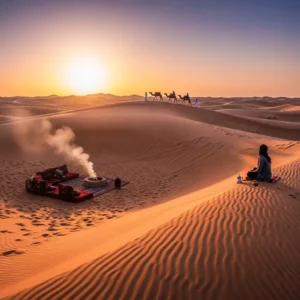
The best time for desert landscape photography is the “golden hour.”
This is shortly after sunrise and just before sunset.
The low angle of the sun casts long, dramatic shadows. This emphasizes the texture of the desert dune types.
Focus on Texture and Lines
The sharp crests of the linear dunes provide strong leading lines.
The ripples on the sand surface add intricate texture.
These details capture the true natural desert beauty of the Dubai Desert Formations.
The Majesty of Scale
Use a person or a lone Ghaf tree to demonstrate the immense scale.
This contrasts the small human presence against the vastness of the geological wonders Dubai.
It adds narrative depth to your sand formation viewing photos.
Deep Dive into Specific Dubai Desert Formations
Let us explore some specific Dubai Desert Formations in greater detail.
The Mystery of Singing Sands
In certain locations, moving sand produces a humming or booming sound.
This phenomenon is known as singing or booming sands. It is a true natural desert beauty marvel.
It is thought to be caused by friction and the thin, uniform shape of the sand grains.
This unusual sound adds an auditory element to the sand formation viewing experience.
The Role of Iron Oxide
The reddish-orange tint of some Dubai Desert Formations comes from iron oxide.
This coating on the quartz grains is a result of weathering processes.
It contributes significantly to the unique desert landscape color palette.
The presence of this mineral is an indicator of the Arabian desert geology.
Fossil Dune Composition
The Fossil Dunes found near Dubai are primarily cemented quartz sand.
The cement is often calcium carbonate. This makes them relatively soft rock.
These geological wonders Dubai are fragile. They are protected by law.
They offer a rare glimpse into the distant past of the Dubai Desert Formations.
Table: Key Desert Dune Types in Dubai
| Dune Type | Characteristic Shape | Formation Wind Pattern | Mobility |
| Barchan (Crescent) | Crescent/Horned | Unidirectional | High |
| Seif (Linear) | Long, Sharp Ridge | Bidirectional/Seasonal | Moderate |
| Star (Pyramidal) | Central Peak, Multiple Arms | Multidirectional | Low |
| Fossil (Lithified) | Irregular, Fixed | Ancient, Cemented | None |
This variety showcases the complexity of the unique desert landscape.
Conservation of Dubai Desert Formations
The natural desert beauty of the Dubai Desert Formations is fragile. It requires protection.
Protecting the Sand Ecosystem
The desert is home to unique, adapted species.
The sand dunes are vital habitats for desert foxes, lizards, and insects.
Uncontrolled vehicle use can destroy this delicate ecosystem.
Responsible travel helps preserve the geological wonders Dubai.
Preserving Fossil Dunes
The Fossil Dunes are irreplaceable natural monuments.
Visitors are urged to view them respectfully. Climbing and vandalism damage their structure.
Their preservation is key to understanding Arabian desert geology.
The Role of Private Reserves
Private reserves often play a key role in protecting the most pristine desert dunes.
They regulate access and manage wildlife.
Exploring these areas offers the highest quality sand formation viewing.
To find ethical operators, you can look at the high standards of companies like https://dubaidesertsafarie.com/.
The Future of Exploring Dubai Desert Formations
Technology is enhancing our ability to study and enjoy these formations.
Satellite Mapping
Satellite imagery is used to track the movement of the highly mobile barchan dunes.
This data helps protect infrastructure that might be in their path.
It provides a scientific understanding of the Dubai Desert Formations dynamics.
Virtual Reality Tours
Future technology may allow virtual tours of protected geological wonders Dubai.
This would allow access without disturbing the unique desert landscape.
This merges technology with the appreciation of natural desert beauty.
Citizen Science
Tourists can contribute to citizen science by reporting wildlife sightings.
They can also share precise locations of unusual Dubai Desert Formations.
This participation enhances the explore Dubai desert experience.
Practical Tips for Sand Formation Viewing
To fully appreciate the Dubai Desert Formations, preparation is essential.
Choose the Right Tour
Look for tours focused on conservation and heritage, not just speed.
These tours prioritize time for quiet sand formation viewing.
They offer deeper insights into the Arabian desert geology.
Essential Gear
Bring a good pair of binoculars for spotting wildlife on the interduneal flats.
A wide-angle lens is essential for capturing the vast scale of the desert dune types.
These tools enhance your exploration of the Dubai Desert Formations.
Respecting the Environment
Always carry out everything you carry in.
Stay on designated trails where possible to protect the unique desert landscape.
Your respect ensures the longevity of the natural desert beauty.
For booking reputable tours that prioritize these features, consider https://hafiztourism.com/.
The Dubai Desert Formations are a testament to the power of nature and time. They are central to the identity of the UAE.
A journey to explore Dubai desert is a journey through deep time. It is an exploration of incredible geological wonders Dubai.
Take the time to appreciate the Dubai Desert Formations. Your understanding of this unique landscape will be profoundly rewarded.
20 Frequently Asked Questions (FAQs) about Dubai Desert Formations
1. What are the most common Dubai Desert Formations, and why are they predominantly red-orange in color?
The most common Dubai Desert Formations are the barchan (crescent) dunes and linear (seif) dunes. They are predominantly red-orange because the quartz sand grains are coated with a thin layer of iron oxide. This iron oxide is essentially rust, which forms over long periods of chemical weathering in the arid environment. This distinct coloration adds to the striking natural desert beauty that travelers seek to explore Dubai desert and capture through desert landscape photography.
2. How fast do the barchan dunes, a type of Dubai Desert Formations, typically move each year?
The mobility of barchan dunes, which are highly dynamic Dubai Desert Formations, varies significantly based on wind strength and sand supply. In the Dubai area, smaller barchan dunes can move several meters—sometimes up to 10 to 20 meters—per year. Larger dunes move slower. This constant movement highlights the living, evolving nature of the unique desert landscape and the constant effect of eolian processes on the sand formation viewing locations.
3. What is the significance of the Fossil Dunes, which are unique Dubai Desert Formations?
The Fossil Dunes are highly significant geological wonders Dubai because they are lithified, or cemented, sand formations from a past era, possibly dating back hundreds of thousands of years. They provide scientists with a crucial record of past climate conditions, including wetter periods. These formations are protected areas due to their fragility and importance to Arabian desert geology, representing the oldest visible Dubai Desert Formations in the region.
4. How can I differentiate between a linear dune (seif) and a crescent dune (barchan) during my exploration of Dubai Desert Formations?
You can differentiate them by shape and crest. The barchan is crescent-shaped with two horns pointing downwind, and it is relatively solitary. The linear dune (seif) is a long, straight ridge that runs parallel to the prevailing wind direction, often forming vast, parallel rows. Observing these distinct desert dune types is key to appreciating the complexity of the Dubai Desert Formations.
5. What role does water play in shaping the Dubai Desert Formations, despite the arid climate?
While the climate is arid, episodic, heavy rainfall leads to flash floods that dramatically shape the Dubai Desert Formations. These floods create wadis (dry riverbeds) and move significant amounts of sediment, carving channels and smoothing surfaces. Furthermore, water contributes to the formation of sabkhas (salt flats) near the coast through the evaporation of groundwater, showcasing another facet of natural desert beauty.
6. Are the sabkha salt flats part of the Dubai Desert Formations safe to walk on, or are they dangerous geological wonders Dubai?
Sabkha salt flats are dangerous geological wonders Dubai and are generally not safe to walk on without expert guidance. While they may appear solid due to a surface crust of salt, this crust is often thin. Beneath it lies soft, waterlogged, or hypersaline mud that can easily trap a vehicle or a person. They are a unique part of the Dubai Desert Formations that should be viewed from a distance to ensure safety during your explore Dubai desert trip.
7. What is the best time of day for desert landscape photography to capture the intricate details of the Dubai Desert Formations?
The best time for desert landscape photography is during the “golden hour,” which occurs shortly after sunrise and just before sunset. During these times, the sun’s low angle creates long, dramatic shadows that emphasize the texture, ripples, and sharp crests of the desert dune types. This lighting enhances the natural desert beauty of the Dubai Desert Formations significantly more than the harsh midday sun.
8. How does the Dubai Desert Formations landscape support desert wildlife, particularly in the interduneal flats?
The interduneal flats, the flat areas between the main Dubai Desert Formations dunes, are vital ecological zones. They collect any available moisture and are the only places where hardy desert flora, like Ghaf and Acacia trees, can take root. These plants support essential desert wildlife, providing food and shelter for species such as the Arabian Oryx, gazelles, and various rodents, which are critical to the unique desert landscape.
9. Can I identify different types of Arabian desert geology just by looking at the color of the sand in the Dubai Desert Formations?
Yes, to some extent. The redder sands often indicate a higher concentration of iron oxide and more time exposed to weathering processes. Whiter or paler sands are often newer or are composed of marine carbonates mixed with the quartz. The study of these color variations is an integral part of understanding the Arabian desert geology of the Dubai Desert Formations.
10. What is a “star dune,” and how does it form compared to other desert dune types in the Dubai Desert Formations?
A star dune is a massive, high, pyramidal structure among the desert dune types. It forms in areas where the wind direction is highly variable, blowing from three or more directions. This multi-directional wind action piles sand up around a central point, creating multiple arms or ridges that radiate from the central peak. This is one of the most impressive Dubai Desert Formations to witness.
11. What is the role of the Al Qudra Lakes area in relation to the surrounding Dubai Desert Formations?
The Al Qudra Lakes are artificial wetlands strategically created within the desert landscape. While not a natural formation, they are an important environmental feature that interacts with the surrounding Dubai Desert Formations. They introduce a water element, attracting migrating birds and creating a localized ecosystem, offering a stark contrast to the typically arid sand formation viewing areas.
12. Are there any restrictions on exploring the Dubai Desert Formations, such as protected areas or conservation zones?
Yes, certain areas of the Dubai Desert Formations, particularly those containing rare wildlife or the fragile Fossil Dunes, are designated as conservation zones, such as the Dubai Desert Conservation Reserve (DDCR). Access to these areas is strictly controlled and usually requires booking with specific, licensed operators, like those found on https://royaldesertadventures.ae/. This protects the unique desert landscape.
13. How do the Beduin people traditionally navigate using the Dubai Desert Formations?
The Beduin developed profound skills in reading the desert. They used the predictable orientation of the large desert dune types (like the linear seif dunes) and the direction of the barchan horns as reliable fixed landmarks. The patterns of the Dubai Desert Formations were essentially their map, allowing them to traverse the Arabian desert geology efficiently.
14. Is it possible to find actual rock formations, rather than just sand, within the Dubai Desert Formations near Dubai?
While the immediate area around Dubai is predominantly sand, if you explore Dubai desert further towards the eastern Hajar Mountains, you will encounter significant rock outcroppings and geological wonders Dubai. These areas feature older sedimentary and igneous rocks, and contain wadis, which are dry riverbeds carved by water flow, showing the pre-sand geological history of the region.
15. What is the “sand ripple” effect, and what causes it on the surface of the Dubai Desert Formations?
The sand ripple effect refers to the small, wave-like ridges visible on the surface of the Dubai Desert Formations dunes. These are caused by the flow of wind across the sand, specifically through the process of saltation (sand grains hopping). The size and spacing of the ripples are directly related to the speed and direction of the wind, making them a fascinating micro-feature for sand formation viewing.
16. How does a guided tour enhance the experience of viewing the Dubai Desert Formations?
A guided tour, especially one focused on the geological wonders Dubai, enhances the experience by providing expert interpretation. Guides can point out subtle differences in the desert dune types, explain the processes of Arabian desert geology, and share the cultural history associated with the Dubai Desert Formations. They also ensure you access the best spots for natural desert beauty safely.
17. Are there different kinds of sand in the Dubai Desert Formations, or is it all the same quartz sand?
While quartz sand dominates the Dubai Desert Formations, there are variations. The inland sands tend to be finer, older, and redder (due to iron oxide). Nearer the coast, the sands often contain more shell fragments and carbonate materials, resulting in a paler, sometimes grayish hue. This compositional variation is part of the unique desert landscape’s complexity.
18. What impact does aggressive dune bashing have on the integrity and ecology of the Dubai Desert Formations?
Aggressive dune bashing, while thrilling, can significantly disrupt the delicate balance of the Dubai Desert Formations. It compacts the sand, destroys the fragile crests of the desert dune types, and crushes the burrows and habitats of small desert animals and plants. Responsible operators, such as those promoting ethical tourism on https://dubaidesertsafarie.com/, minimize this impact.
19. How do seasonal changes affect the appearance and accessibility of the Dubai Desert Formations?
Seasonal changes, primarily temperature variations, affect the Dubai Desert Formations mostly in terms of accessibility and comfort. In the summer, the heat makes prolonged sand formation viewing difficult. The occasional winter rain, however, can briefly stabilize the surface sand and even lead to temporary desert blooms, transforming the natural desert beauty and making the unique desert landscape look quite different.
20. Where can I find reputable tour operators that offer educational trips focused on the geological wonders Dubai and the Dubai Desert Formations?
Reputable tour operators that focus on educational and conservation-minded exploration of the Dubai Desert Formations can be found by researching companies that emphasize heritage and geology. Look for operators endorsed by conservation bodies. Reliable choices that prioritize the unique desert landscape can be found on established platforms like https://hafiztourism.com/ and those specializing in conservation-focused tours.