

Desert Safari Camps 10 Amazing Secrets of Invisible Construction
Have you ever wondered how Desert Safari Camps appear in the middle of nowhere?
One day, there is nothing but endless sand.
The next day, there is a bustling village.
It is filled with lights, stages, and kitchens.
Then, just as quickly, it can disappear.
The sand returns to its pristine state.
It is like a magic trick.
But it is not magic.
It is a feat of engineering and logistics.
Building Desert Safari Camps is a complex process.
It requires strict adherence to environmental laws.
It requires sustainable materials.
It requires a “Leave No Trace” philosophy.
The Dubai desert is a protected ecosystem.
We cannot just pour concrete everywhere.
We cannot leave trash behind.
The construction must be temporary yet safe.
It must be robust enough to withstand storms.
Yet, it must be light enough to be removed.
This balance is hard to achieve.
It involves solar power and water recycling.
It involves biodegradable materials.
In this massive guide, we will explore every detail.
We will look at how the site is chosen.
We will look at how the materials are transported.
We will look at how waste is managed.
And finally, how the Desert Safari Camps vanish without a trace.
The Philosophy of Invisible Architecture
The core concept is invisibility.
Not while the camp is there, of course.
But after it is gone.
The desert memory should be short.
When we build Desert Safari Camps, we borrow the land.
We do not own it.
Nature owns it.
Therefore, the architecture must be non-invasive.
We avoid deep foundations.
We avoid permanent cement structures.
We use anchors that can be unscrewed.
We use platforms that float on the sand.
This ensures the subsurface is not disturbed.
The insects and small animals underground stay safe.
When the season ends, we pack up.
We sweep the sand.
We use magnets to pick up nails.
We ensure that the next visitor sees only nature.
This is the standard set by the government.
Companies like https://royaldesertadventures.ae/ are leaders in this.
They understand the delicate balance.
They invest in eco-friendly technologies.
It is about respect.
Respect for the Bedouin history.
Respect for the future generations.
If we destroy the desert, we have no business.
So, sustainability is survival.
Site Selection and Environmental Permits
Before a single pole is driven into the sand, we plan.
Choosing a site for Desert Safari Camps is scientific.
We cannot just pick a pretty dune.
We have to check the wind patterns.
We have to check the wildlife corridors.
Are there Gazelles migrating through here?
Is this a nesting ground for lizards?
If yes, we cannot build.
We work with environmental agencies.
We get satellite data.
We conduct ground surveys.
The site must be accessible by 4×4.
But it should not be too close to the road.
It needs to feel isolated.
It needs to offer sunset views.
Once a site is identified, we apply for permits.
The Dubai Municipality is very strict.
They require an Environmental Impact Assessment (EIA).
This document details everything.
It lists the number of guests.
It lists the waste management plan.
It lists the noise levels.
Only after approval can we start.
This process takes months.
It ensures that Desert Safari Camps are legal and safe.
Unlicensed camps are shut down immediately.
We follow the rules to the letter.
Transporting Materials Across the Dunes
Logistics in the desert is a nightmare.
Trucks get stuck.
Heavy machinery sinks.
Building Desert Safari Camps requires special transport.
We use 6×6 trucks.
We lower tire pressures significantly.
We plan the route to avoid soft pockets.
Sometimes, we cannot use trucks.
We have to use smaller pickups.
We ferry materials in small batches.
It is time-consuming.
It adds to the cost.
But it prevents damage to the dunes.
A heavy truck creates deep ruts.
These ruts take years to heal by wind.
So we tread lightly.
We use wide tires to distribute weight.
We bring in the heavy generators first.
Then the water tanks.
Then the structural beams.
Everything is modular.
It is like a giant Lego set.
It is designed to be carried by hand if needed.
Workers are trained in desert safety.
They know how to handle heat.
They know how to lift on uneven ground.
Transport is the backbone of Desert Safari Camps.
Without it, there is no camp.
The Foundation: No Concrete Allowed
This is the most interesting part.
How do you build a stage without concrete?
How do you build a kitchen without a slab?
For Desert Safari Camps, we use sand anchors.
These are long metal screws.
They are twisted deep into the sand.
They provide immense holding power.
But they can be unscrewed later.
They leave no rock or cement behind.
On top of these anchors, we build a frame.
Usually, it is steel or treated wood.
We create a floating platform.
This platform is level.
The sand underneath is uneven.
But the floor is flat.
This protects the sand from compaction.
It allows air to flow underneath.
It prevents moisture buildup.
It also keeps scorpions out of the tents.
This raised floor system is standard.
It is expensive but necessary.
It is the secret to the “Without a Trace” promise.
When we leave, we reverse the screw.
The sand fills the hole instantly.
It is as if we were never there.
Sustainable Materials: Wood and Goat Hair
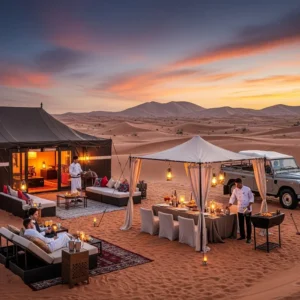
The look of Desert Safari Camps is traditional.
We use materials that blend in.
We do not use shiny plastic.
We do not use bright metal.
We use natural wood.
We use palm fronds (Barasti).
We use goat hair tents.
These materials are biodegradable.
If a piece of palm frond falls, it is okay.
It returns to the earth.
Goat hair tents are amazing.
They are waterproof when wet.
The fibers swell and seal the gaps.
They are breathable when dry.
They keep the interior cool.
This is ancient Bedouin technology.
We combine it with modern safety.
The wood is treated with eco-friendly fire retardant.
The fabrics are fire-resistant.
We verify sources.
We ensure the wood is sustainable.
We ensure the goat hair is ethically sourced.
Companies like https://dubaidesertsafarie.com/ promote this style.
They value the authentic look.
It feels real because it is real.
It is not a movie set.
It is a functioning traditional dwelling.
Water Management in the Desert
Water is gold in the desert.
Desert Safari Camps need a lot of it.
Guests need to wash hands.
Kitchens need to clean plates.
Toilets need flushing.
Where does it come from?
We bring it in tankers.
Every drop is accounted for.
We use low-flow faucets.
We use aerators to reduce consumption.
But the big question is: where does it go?
We cannot dump soapy water in the sand.
It would kill the plants.
It would pollute the groundwater.
We use sealed septic tanks.
These are huge underground containers.
They are double-walled to prevent leaks.
All waste water goes there.
Every night, a tanker comes.
It sucks the waste out.
It takes it to a municipal treatment plant.
This is a daily operation.
It is invisible to the guest.
You wash your hands and forget.
But behind the scenes, it is a strict cycle.
We monitor the tank levels constantly.
Overflowing is not an option.
It is a hygiene hazard.
It is an environmental crime.
We treat the desert with care.
Powering the Camp: Solar and Generators
Electricity is essential.
We need lights for the stage.
We need power for the sound system.
We need fridges for the food.
Desert Safari Camps are off-grid.
There are no power lines here.
Traditionally, we used diesel generators.
They are reliable.
But they are noisy and smoky.
Now, things are changing.
We are shifting to solar power.
The desert has unlimited sun.
We install solar panels on the roofs.
We use battery banks to store energy.
This powers the LED lights at night.
It is silent.
It is clean.
For heavy loads like AC, we still use generators.
But we use silent generators.
We put them in sound-proof boxes.
We place them far from the guest area.
We use bio-diesel when possible.
We are reducing our carbon footprint.
Every kilowatt saved is fuel saved.
We use motion sensors for lights.
If no one is in the toilet, the light goes off.
Smart energy management is key.
It saves money and nature.
Waste Management and Recycling
Tourists produce trash.
Plastic bottles, napkins, food scraps.
In Desert Safari Camps, this is a challenge.
The wind is our enemy.
If a napkin drops, the wind takes it.
It can fly for miles.
It can get stuck in a bush.
A camel might eat it.
So, we have strict protocols.
We have bins everywhere.
They have heavy lids.
The wind cannot open them.
We have staff constantly patrolling.
They pick up every tiny piece of paper.
We segregate waste.
Plastic, glass, paper, organic.
We compact the trash on site.
This reduces the volume.
It means fewer truck trips.
Food waste is kept in sealed containers.
It prevents attracting foxes and flies.
We work with recycling companies in the city.
We ensure the plastic is actually recycled.
https://hafiztourism.com/ is very strict about this.
They educate their guests too.
They ask guests to be mindful.
“Take only memories, leave only footprints.”
This is the motto.
A clean camp is a safe camp.
The Kitchen Setup: Mobile and Hygienic
The kitchen is the heart of the camp.
Feeding hundreds of people requires a pro setup.
But in Desert Safari Camps, it must be mobile.
We use modular kitchen units.
They are stainless steel.
They are easy to clean.
They are mounted on wheels or skids.
We bring gas cylinders for cooking.
Safety is paramount here.
Gas sensors are installed.
Fire extinguishers are everywhere.
The flooring in the kitchen is sealed.
No grease can touch the sand.
We use grease traps.
They catch the oil from the washing up.
This oil is collected and recycled.
It never touches the ground.
Hygiene standards are the same as a 5-star hotel.
Inspectors visit us.
They check the temperature logs.
They check the cleanliness.
Building a kitchen in the sand is hard.
Keeping it sand-free is harder.
We use positive pressure ventilation.
It pushes air out.
It prevents dust from coming in.
It keeps the food safe.
It keeps the chefs happy.
Safety and Fire Prevention
Fire is a big risk.
Dry palm fronds burn fast.
Tents are flammable.
Desert Safari Camps are built with fire breaks.
We leave space between structures.
If one tent catches fire, it won’t spread.
We treat all materials with fire retardants.
We have a massive water reserve.
It is dedicated to fire fighting.
We have pumps and hoses.
Staff are trained as fire marshals.
They know how to react.
We hold drills regularly.
We simulate a fire.
We practice evacuation.
The assembly point is usually a high dune.
It is away from the fuel and gas.
We also worry about storms.
Sandstorms can be violent.
Structures must be wind-rated.
We use cross-bracing.
We use tension cables.
The camp must not collapse in the wind.
Safety is engineered into the design.
It is not an afterthought.
It is the primary constraint.
The Role of Technology
Modern Desert Safari Camps are high-tech.
We use apps to monitor systems.
We check tank levels remotely.
We check battery voltages on phones.
We use GPS to track vehicles.
We use weather apps to predict storms.
This data helps us manage the camp.
If a storm is coming, we secure everything.
If water is low, we order a truck.
Automation reduces human error.
It makes the operation efficient.
We also use tech for guests.
Digital waivers.
QR codes for menus.
It reduces paper waste.
It improves the user experience.
Technology helps us be invisible.
It helps us operate cleanly.
It connects the remote desert to the control center.
Seasonal Teardown: The Great Vanishing
Summer in Dubai is intense.
Temperatures reach 50 degrees Celsius.
Many Desert Safari Camps close for the summer.
Or they scale down.
This is when the teardown happens.
It is the reverse of construction.
We start with the fabrics.
We remove the carpets and cushions.
We clean them and store them in warehouses.
We take down the tents.
We dismantle the wooden frames.
We unscrew the anchors.
We remove the solar panels.
We empty the septic tanks.
We remove the tanks themselves.
Then comes the cleaning.
We form a line of workers.
They walk across the site.
They comb the sand.
They look for screws, bottle caps, wire bits.
They use magnets.
They sift the top layer of sand.
It is tedious work.
But it is essential.
When we leave, the site looks untouched.
The wind blows over the tracks.
In a week, you cannot tell a camp was there.
This is the promise of removal without a trace.
It allows the desert to heal.
It allows the plants to regrow.
It prepares the site for the next season.
The Cost of Sustainability
Building this way is not cheap.
Eco-friendly materials cost more.
Solar power has a high setup cost.
Waste recycling costs money.
Transporting water is expensive.
Desert Safari Camps have high overheads.
Cheap camps cut corners.
They might dump water in the sand.
They might use cheap diesel generators.
They might leave trash behind.
That is why you should avoid cheap tours.
When you pay a bit more, you pay for nature.
You pay for the proper disposal of your waste.
You pay for the solar panels.
Operators like https://royaldesertadventures.ae/ invest heavily.
They do not compromise.
They know that sustainability is the future.
If the desert is ruined, their business dies.
So, the cost is an investment.
It is the price of doing business responsibly.
The Human Element: Staff and Living
The staff often live on-site.
Or nearby in accommodation camps.
Their living conditions matter.
If they live in Desert Safari Camps, they need comfort.
They need AC.
They need showers.
Their quarters are built to the same standards.
Happy staff run a good camp.
They are the guardians of the site.
They are the ones who pick up the trash.
They are the ones who spot the leaks.
We train them to love the desert.
Many of them come from green countries.
The desert is strange to them.
We teach them about its beauty.
We teach them to respect the silence.
They become the protectors of the dunes.
Their role is vital in the construction and maintenance.
They are the eyes and ears on the ground.
Future Trends in Desert Architecture
The future of Desert Safari Camps is exciting.
We are looking at 3D printed structures.
Using sand as the material.
We are looking at completely autonomous camps.
Robots cleaning the sand.
We are looking at hydrogen power.
Zero emission generators.
We are looking at water-from-air technology.
Extracting moisture from the humidity.
This would eliminate water trucks.
It would reduce the carbon footprint massively.
The industry is innovating.
Dubai wants to be the greenest city.
The desert tourism sector is part of that.
We are moving towards “Regenerative Tourism.”
Not just leaving no trace.
But making the place better.
Planting more Ghaf trees.
protecting more wildlife.
The Desert Safari Camps of the future will be living labs.
They will be examples of extreme sustainability.
Comparing Temporary vs Permanent Camps
There are two types of camps.
Temporary Camps: Built for the winter season. Removed completely in summer. Lighter materials. More authentic feel. Zero footprint.
Permanent Camps: Built to stay all year. Usually in designated resorts. Concrete might be used. AC is powerful. More luxury. Higher environmental impact.
Most authentic Desert Safari Camps are temporary.
They follow the Bedouin way.
Bedouins were nomads.
They moved with the seasons.
They never built stone houses in the dunes.
They lived lightly.
We mimic this lifestyle.
Permanent camps are basically hotels.
They are nice, but they change the land.
Temporary camps respect the land.
They are guests, not owners.
This distinction is important.
Real eco-tourism favors the temporary.
The Wildlife Perspective
How do animals react to Desert Safari Camps?
If built well, they don’t mind.
Foxes are curious.
They come looking for food.
That is why we seal the bins.
If we feed them, they lose their hunting instinct.
It is bad for them.
So we have a “No Feeding” policy.
Camels are often owned by nearby farms.
They wander through the camp.
They are part of the landscape.
Lizards hide under the platforms.
It gives them shade.
Birds perch on the tents.
If we use quiet generators, they stay.
If we use loud ones, they leave.
The noise pollution is the biggest factor.
Solar power helps the wildlife.
It keeps the desert quiet.
We want the animals to thrive.
They are part of the attraction.
Seeing a wild Oryx is a highlight.
We build to coexist.
Legal Penalties for Non-Compliance
Dubai is strict.
If you mess up, you pay.
Dumping waste? Huge fine.
Building without a permit? Demolition.
Leaving trash? License suspension.
Inspectors monitor Desert Safari Camps.
They use drones.
They do surprise visits.
They check the septic records.
They check the staff visas.
This regulation is good.
It keeps the cowboys out.
It ensures only serious operators survive.
It protects the reputation of Dubai.
Tourists feel safe knowing this.
They know the camp is inspected.
They know the food is safe.
They know the environment is watched.
Adhering to these laws is part of the construction process.
It guides every decision.
Innovative Decor and Lighting
Decoration makes the mood.
But it must be sustainable.
We use solar lanterns.
We use recycled glass jars.
We use natural fabrics.
In Desert Safari Camps, lighting is crucial.
It should not be too bright.
Light pollution hides the stars.
We use warm, low-level LEDs.
We aim them downwards.
This preserves the dark sky.
It creates a cozy atmosphere.
We use traditional carpets.
They are heavy and durable.
They anchor the sand.
They provide walkways.
Decor is not just pretty.
It is functional.
It protects the feet from hot sand.
It defines the zones.
It tells a story of heritage.
All of it must be removable.
Nothing is glued to the ground.
Everything is packed up in summer.
The Guest’s Role in Conservation
Guests are partners.
When you visit Desert Safari Camps, you have a role.
Don’t drop cigarette butts.
They are toxic.
Don’t bury trash in the sand.
Wind will uncover it.
Use the recycling bins.
Save water in the washrooms.
Don’t take sand as a souvenir (it disturbs the dune).
Respect the rules.
Operators like https://dubaidesertsafarie.com/ educate guests.
They give briefings.
They explain the eco-system.
When guests understand, they care.
They become eco-warriors.
They appreciate the effort behind the camp.
They understand why the floor is raised.
They understand why the lights are dim.
It enhances their experience.
It makes them feel good about their trip.
Final Thoughts on Desert Engineering
Building Desert Safari Camps is an art.
It is a blend of old wisdom and new tech.
It is a commitment to nature.
We build to share the beauty of Dubai.
But we build to protect it too.
The ability to remove a village without a trace is a superpower.
It shows that humans can enjoy nature without destroying it.
It is a model for tourism worldwide.
Next time you sit on a cushion in the desert, look around.
Look at the wood.
Look at the lights.
Think about the septic tank underground.
Think about the solar panels.
Appreciate the invisible work.
It is there to ensure that your children can see the same dunes.
It is there to keep the magic alive.
Book your sustainable tour today.
Choose operators who build responsibly.
Use https://royaldesertadventures.ae/ for verified eco-camps.
Check https://hafiztourism.com/ for authentic experiences.
Enjoy the desert.
Respect the sand.
Leave no trace.
FAQ: Desert Safari Camp Construction
1. Are Desert Safari Camps permanent structures?
Most authentic Desert Safari Camps are temporary or semi-permanent. They are designed to be dismantled. In Dubai, many camps are taken down or significantly reduced during the hot summer months to protect the materials and allow the desert environment to recover. The structures use anchors and modular frames rather than concrete foundations, making them fully removable without leaving a trace.
2. How do camps get electricity in the middle of the desert?
Camps are off-grid, meaning they are not connected to city power lines. They rely on a combination of diesel generators and solar power. Modern eco-friendly camps are increasingly switching to solar panels with battery storage for lighting and light appliances. For heavy loads like air conditioners and kitchen equipment, silent generators enclosed in soundproof boxes are used to minimize noise pollution.
3. Where does the toilet waste go?
This is a common question! Desert Safari Camps use large, sealed underground septic tanks. All wastewater from toilets and sinks flows into these tanks. They are strictly monitored to prevent leaks. Specialized sewage tanker trucks visit the camps daily or every few days to pump out the waste and transport it to municipal treatment plants in the city. Nothing is dumped in the desert.
4. How is the food kept fresh without a proper building?
The camp kitchens are marvels of mobile engineering. They use industrial-grade stainless steel units powered by generators. They have commercial refrigerators and freezers to keep meat and produce at safe temperatures. Health inspectors from the Dubai Municipality regularly visit these remote kitchens to check temperature logs and hygiene standards, ensuring the food is as safe as in any city restaurant.
5. Do the camps damage the sand dunes?
Responsible operators take great care to minimize damage. They use designated tracks for transport trucks to avoid scarring pristine dunes. The camps are built on raised platforms or in flat valleys to avoid flattening the dune structures. When the camp is removed, the site is swept and magnetically cleaned to ensure the sand returns to its natural state, driven by the wind.
6. What materials are used to build the tents?
Traditional materials are favored for their look and function. Goat hair is commonly used for the tent fabrics because it is breathable and naturally water-resistant. Palm fronds (Barasti) are used for roofs and fencing. Structural frames are made of treated timber or steel. These materials are biodegradable or recyclable, fitting the “Leave No Trace” philosophy of Desert Safari Camps.
7. How do you stop the camp from flying away in a sandstorm?
The desert wind can be powerful. Camps are engineered with aerodynamics in mind. Tents are securely anchored deep into the sand using long screw piles or heavy weights buried underground. Cross-bracing is used on wooden frames to provide rigidity. The low profile of traditional Bedouin tents also helps the wind pass over them rather than pushing them over.
8. Is there running water in the bathrooms?
Yes, there is running water. Fresh water is brought to the camp in large tanker trucks and stored in overhead or ground-level tanks. Pumps provide pressure to the taps and toilets. However, because water is a precious resource that has to be trucked in, camps use water-saving faucets and aerators. Guests are always encouraged to use water sparingly.
9. Can I visit the camp during the day?
Usually, Desert Safari Camps come alive in the late afternoon for the evening tours. During the day, they are often in maintenance mode—cleaning, restocking, and repairing. However, morning safari guests might visit for a short time. The heat in the middle of the day makes the open-air camp uncomfortable, which is why the main operations are timed for the cooler evenings.
10. How long does it take to build a camp?
Building a full-scale camp from scratch can take 4 to 8 weeks. It involves site leveling (minimal), installing anchors, building the wooden decks, erecting the tents, and installing the plumbing and electrical systems. Dismantling it is faster, usually taking about 2 weeks. The permitting process before construction takes the longest, often several months of environmental approvals.
11. Are there fire extinguishers at the camp?
Yes, safety is strictly regulated. Fire extinguishers are placed at strategic points throughout the camp, especially near the kitchen, generator, and smoking areas. The materials used for tents and decorations are treated with fire-retardant chemicals. Staff are trained in fire safety and evacuation procedures to handle emergencies in the remote location.
12. Why are the floors raised in some areas?
Raising the floors on wooden decks serves multiple purposes. It creates a flat surface for tables and chairs on uneven sand. It prevents scorpions and insects from easily crawling onto the seating areas. It allows air to circulate underneath, keeping the floor cooler. And importantly, it protects the sand beneath from being compacted by thousands of footsteps.
13. Do solar panels work well in the desert?
Yes, the desert offers abundant sunlight, making it perfect for solar power. However, the dust and sand are a challenge. Solar panels on Desert Safari Camps need to be cleaned frequently—sometimes daily—to maintain efficiency. The high heat can also reduce the efficiency of some panels, so specialized heat-resistant equipment is often used.
14. What happens to the trash left by tourists?
Waste management is a critical daily operation. Staff patrol the camp continuously to pick up litter. Bins are wind-proof. After the guests leave, the waste is sorted into recyclables and general waste. It is then compacted and trucked back to the city for proper disposal and recycling. Zero waste is left at the site overnight to avoid attracting wildlife.
15. Can I sleep in these camps?
Yes, on an Overnight Desert Safari. You can sleep in the tents or under the stars. The camp provides sleeping bags, mattresses, and blankets. Some luxury camps have permanent-style rooms with beds, but the authentic experience is sleeping in the traditional semi-permanent structures that let you hear the sounds of the desert night.
16. How do they keep the camp cool in summer?
In summer, camps that stay open use large outdoor coolers (desert coolers) that blow mist and air. They also schedule tours for the late evening when it is cooler. The traditional goat hair tents are naturally insulating, keeping the sun’s heat out. However, the best cooling is the natural breeze, which is why open-sided designs are preferred.
17. Why do some camps look different than others?
There are different styles. “Fortress” camps look like old mud forts (actually made of wood and plaster finish). “Bedouin” camps are made of fabric and palm fronds. The style depends on the theme the operator wants—historic military fort or nomadic village. Companies like https://royaldesertadventures.ae/ focus on the authentic Bedouin village look for a genuine feel.
18. Is it safe to walk barefoot in the camp?
In the main carpeted areas and clean sand areas, yes. It is very comfortable. However, around the edges of the camp or in the dark, it is better to wear shoes to avoid sharp twigs or hidden insects. The staff clean the sand daily, often sifting it to remove debris, making the central areas safe for barefoot walking.
19. How deep are the anchors buried?
The metal screw anchors can go 1 to 2 meters deep into the sand. This depth is needed to reach the more compacted sand layers and provide enough friction to hold the structures steady against heavy winds. It is a non-permanent foundation method that rivals concrete in strength for these lightweight structures.
20. Why should I choose an eco-friendly camp?
Choosing an eco-friendly camp ensures that your visit does not harm the beautiful landscape you came to admire. It supports sustainable business practices and helps preserve the local wildlife. Operators listed on https://dubaidesertsafarie.com/ often highlight their eco-credentials. It might cost a little more, but it guarantees a guilt-free and responsible adventure.