

Future of Desert Safari Tourism 19 Innovations Shaping the Sands
The desert has always been a place of mystery.
For centuries, it was a barrier to cross.
Then, it became a playground for adventure.
Now, we are standing on the brink of a new era.
The Future of Desert Safari Tourism is not just about faster cars.
It is about a complete transformation of the experience.
We are moving from consumption to conservation.
We are moving from generic tours to hyper-personalized journeys.
Technology is merging with tradition in ways we never imagined.
Sustainability is no longer a buzzword; it is the foundation.
Imagine a safari where the vehicle leaves no carbon footprint.
Imagine a camp that is powered entirely by the sun.
This is not science fiction.
It is happening right now in Dubai.
The government is pushing for green tourism.
Operators are investing in new technologies.
Tourists are demanding more meaningful experiences.
This guide will take you into the future.
We will explore the innovations that are reshaping the dunes.
We will look at how AI, VR, and EVs are changing the game.
We will see how luxury is being redefined.
Get ready to see the desert in a whole new light.
The Shift Towards Sustainable Adventure
The biggest trend is sustainability.
For years, desert safaris were about conquering nature.
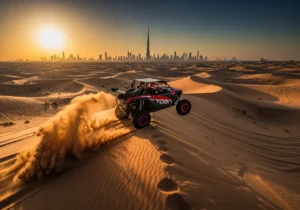
Heavy V8 engines roared through the silence.
Plastic bottles were left behind.
This model is dying.
The future is about coexistence.
The Future of Desert Safari Tourism prioritizes the environment.
New regulations are limiting the environmental impact.
Operators are adopting “Leave No Trace” policies strictly.
Carbon offsetting is becoming standard.
When you book a ticket, a portion goes to planting trees.
Or it goes to protecting the Arabian Oryx.
This shift is driven by the travelers themselves.
Gen Z and Millennials care about their footprint.
They do not want to destroy the places they visit.
They choose operators who respect the land.
Companies like https://royaldesertadventures.ae/ are leading this change.
They are implementing waste reduction strategies.
They are educating guests about the ecosystem.
Sustainability is the new luxury.
Electric Vehicles in the Dunes
The roar of the engine is iconic.
But silence is the future.
Electric Vehicles (EVs) are entering the desert.
Electric SUVs have massive torque.
This makes them perfect for dune bashing.
They deliver power instantly to the wheels.
This allows for smoother, more controlled climbing.
But the best part is the silence.
Imagine gliding over a dune without engine noise.
You can hear the shifting sand.
You can hear the wind.
It is a more immersive experience.
It disturbs the wildlife less.
Charging stations are being built at desert gates.
Solar-powered chargers make the loop completely green.
Hybrids are the bridge technology.
Many operators are switching to hybrid Land Cruisers.
They save fuel on the highway drive.
They use power efficiently in the sand.
By 2030, we might see fully electric fleets.
This will reduce the carbon footprint of the industry massively.
Smart Desert Camps
The camp of the future is smart.
Internet of Things (IoT) is being integrated.
Sensors monitor energy usage.
They adjust lighting based on occupancy.
Smart water systems recycle greywater.
This water is used for desert plants.
Guests can control their tent environment with an app.
You can set the AC temperature before you arrive.
You can order room service via a tablet.
Safety is also enhanced.
Smart wristbands track guests in the camp.
If a child wanders off, they are easily found.
Connectivity is seamless.
High-speed 5G is available even in remote areas.
You can live-stream your sunset moment.
But smart camps also know when to disconnect.
They offer “digital detox” zones.
Areas where signals are blocked to encourage conversation.
It is a balance of tech and tranquility.
Artificial Intelligence Personalization
AI is changing how we book.
It is changing how we experience the tour.
In the past, you chose Package A or Package B.
In the Future of Desert Safari Tourism, the package chooses you.
AI algorithms analyze your preferences.
Do you like history?
Do you like thrill rides?
Do you have dietary restrictions?
The system builds a custom itinerary.
It suggests the best time to go based on weather data.
It predicts the sunset quality.
During the safari, AI assistants guide you.
Chatbots answer your questions instantly.
“What is that bird?”
“How old is this dune?”
The AI provides accurate, instant information.
It acts as a digital naturalist.
This level of personalization was impossible before.
Now, every guest gets a unique experience.
Virtual Reality Previews
Unsure if dune bashing is for you?
Try it in VR first.
Booking centers are using Virtual Reality.
You put on a headset.
You feel the drop of the dune.
You see the view from the camp.
This helps manage expectations.
It reduces anxiety for nervous travelers.
It excites the adventure seekers.
VR is also used for education.
In the ride to the desert, you might wear a headset.
You see the desert as it was 100 years ago.
You see Bedouins crossing the sands.
You see the wildlife that is hiding.
It adds a layer of history to the visual.
Augmented Reality (AR) is also big.
Point your phone at a plant.
The app tells you its name and uses.
Point it at the sky.
It outlines the constellations.
This makes the safari educational and interactive.
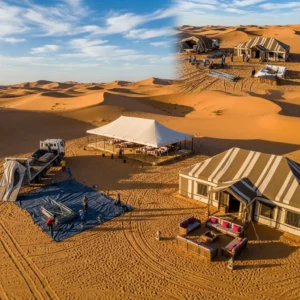
The Rise of Glamping Resorts
Camping is getting an upgrade.
Glamping (Glamorous Camping) is the trend.
The tents are permanent structures.
They have glass walls for star gazing.
They have private plunge pools.
They have en-suite bathrooms with rain showers.
The Future of Desert Safari Tourism is about comfort.
People want the wild without the hardship.
These resorts are eco-friendly.
They use solar power.
They are built on stilts to protect the sand.
They offer butler service.
You can have a private chef cook your BBQ.
You can have a spa treatment in the dunes.
This attracts a high-end clientele.
It positions Dubai as a premier luxury destination.
Operators like https://dubaidesertsafarie.com/ act as gateways to these resorts.
They curate the best luxury options.
It is a move away from mass tourism.
It focuses on low volume, high value.
Drone Photography and Videography
Selfies are so 2020.
The future is drone shots.
Tourists want cinematic memories.
Safaris now employ drone pilots.
They follow your car over the dunes.
They capture the scale of the desert.
You get a 4K video of your adventure.
It looks like a movie trailer.
This content is perfect for social media.
It drives marketing for the operators.
Drones are also used for safety.
They can scout the path ahead.
They can check for other vehicles.
They can help in search and rescue if needed.
Some camps offer drone shows.
Instead of fireworks, hundreds of drones light up the sky.
They form shapes of camels and falcons.
It is a silent, sustainable light show.
It respects the quiet of the desert.
Culinary Innovation
The food is evolving.
The standard buffet is being replaced.
We are seeing “farm-to-table” in the desert.
Hydroponic farms are growing vegetables in the sand.
You eat salad that was grown meters away.
It is fresh and sustainable.
Gourmet dining is becoming standard.
Chefs are reimagining Bedouin cuisine.
Camel meat burgers with truffle oil.
Date pudding with gold leaf.
It is a fusion of tradition and modern luxury.
Dining experiences are becoming private.
You don’t have to sit in a crowded hall.
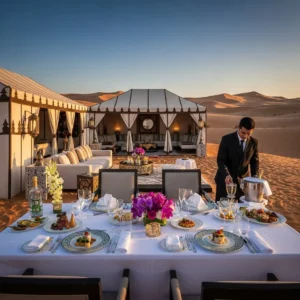
You can have a private table on a dune.
A waiter serves you a multi-course meal.
The lighting is provided by candles.
This romantic setting is in high demand.
It transforms a meal into a memory.
Cultural Preservation via Tech
Culture is the soul of the safari.
Technology helps preserve it.
Holograms are used to tell stories.
You sit around the fire.
A hologram of an old storyteller appears.
He tells legends of the past.
It feels ghostly and magical.
Digital archives preserve the songs.
You can listen to traditional music on high-quality headphones.
Museums are being built in the desert.
They use interactive displays.
They explain the falaj irrigation system.
They show the history of pearl diving.
This deepens the cultural understanding.
It moves beyond the superficial belly dance.
It teaches respect for the heritage.
Guests leave with knowledge, not just sand in their shoes.
Wellness and Mindfulness
The desert is a place of healing.
The Future of Desert Safari Tourism embraces wellness.
Yoga retreats are popular.
Sunrise yoga on the dunes.
Meditation sessions at sunset.
Sound healing with Tibetan bowls.
The silence of the desert supports this.
It is an escape from the city noise.
Mental health is a priority for travelers.
They seek destinations that recharge them.
Camps are offering wellness packages.
Detox juices instead of soda.
Healthy food options.
Massage therapists on site.
It attracts a new demographic.
People who are not interested in bashing.
People who want peace.
https://hafiztourism.com/ offers packages that cater to this slower pace.
They focus on the serenity of the environment.
Conservation Tourism
Tourists want to help.
“Citizen Science” is a trend.
Guests participate in conservation.
You might help plant a Ghaf tree.
You might help track an Oryx herd.
You collect data for scientists.
This makes the trip meaningful.
You are not just taking; you are giving back.
The Dubai Desert Conservation Reserve is a model.
They limit the number of cars.
They enforce strict rules.
The result is a thriving ecosystem.
Tourists pay a premium to enter.
They are happy to support the cause.
This model will expand to other areas.
It proves that conservation pays.
It ensures the desert survives for the next generation.
Advanced Safety Systems
Safety tech is advancing.
Vehicles are equipped with roll-over sensors.
They automatically alert the control center.
GPS tracking is precise.
The operator knows exactly where every car is.
Geofencing prevents drivers from entering dangerous zones.
It keeps them away from wildlife breeding grounds.
It keeps them away from private property.
Driver monitoring systems are used.
Cameras watch the driver’s eyes.
If they look tired, an alarm sounds.
If they drive too aggressively, the manager is notified.
This ensures a high standard of driving.
It reduces accidents.
It gives peace of mind to the guests.
Especially families with children.
Safety is invisible but essential.
The Role of Robotics
Robots are entering the workforce.
In the camp, robot waiters might serve drinks.
They can navigate the sand on tracks.
They carry heavy trays.
This reduces the burden on staff.
It is a novelty for guests.
Cleaning robots keep the camp pristine.
They sift the sand to remove small trash.
They clean the solar panels.
Robotic falcons are used for training.
They fly like real birds.
Real falcons chase them.
It saves live prey.
It is an ethical way to demonstrate the sport.
Technology supports tradition.
Space Tourism Connection
The desert looks like Mars.
Dubai is investing in space.
The two are converging.
“Mars Science City” is being built.
It simulates life on the Red Planet.
Tourists can visit this simulation.
They can experience space training.
They can sleep in “Mars domes.”
The Future of Desert Safari Tourism includes space themes.
Stargazing is enhanced with high-tech telescopes.
Astronomers guide the session.
You look at planets and nebulae.
It connects the desert to the cosmos.
It appeals to the sci-fi fans.
It differentiates Dubai from other deserts.
The “Hyper-Loop” Effect
Transport to the desert will change.
The Hyperloop concept is being discussed.
It could cut travel time to minutes.
You could reach deep desert resorts instantly.
Autonomous flying taxis are another possibility.
You fly from the city to the camp.
You avoid the highway traffic.
You get an aerial view of the dunes.
This makes the desert more accessible.
It allows for shorter trips.
You could go for a quick lunch and be back for a meeting.
It integrates the desert into daily life.
Logistics will no longer be a barrier.
Dynamic Pricing Models
Pricing is becoming smarter.
Airlines use dynamic pricing.
Safari operators are adopting it.
Prices change based on demand.
Sunset slots cost more.
Weekday slots cost less.
AI predicts the demand.
This helps distribute the crowd.
It encourages people to visit at off-peak times.
It maximizes revenue for operators.
It offers deals for flexible travelers.
Smart booking platforms make this transparent.
You can see the price fluctuations.
You can choose the best value option.
The Growth of Niche Markets
One size does not fit all.
The market is fragmenting.
There are safaris for solo women.
Safaris for photographers.
Safaris for bird watchers.
Safaris for pet owners.
Specialization is the key to growth.
Operators are creating niche brands.
They cater to specific interests.
This builds loyalty.
If you are a cyclist, you want a fat-bike safari.
If you are an artist, you want a painting safari.
The Future of Desert Safari Tourism is diverse.
It creates a menu of experiences.
Regenerative Tourism
Sustainability minimizes harm.
Regenerative tourism does good.
It heals the land.
Camps are creating biodiversity zones.
They are reintroducing native species.
They are fixing the soil.
Tourists are part of this healing.
Their fees fund the regeneration.
Their presence discourages poaching.
It turns tourism into a force for good.
It improves the destination.
The desert becomes healthier because tourists are there.
This is the ultimate goal.
It ensures longevity.
Conclusion
The future is bright.
The future is green.
The future is exciting.
The Future of Desert Safari Tourism is a blend of high-tech and deep roots.
It respects the past while embracing the tomorrow.
Dubai is the laboratory for this innovation.
What happens here sets the standard for the world.
The days of just “bashing dunes” are over.
The era of meaningful, sustainable, and smart adventures has begun.
Whether you are a thrill-seeker or a peace-seeker, the desert has something new for you.
It is cleaner, safer, and more immersive than ever.
So, pack your bags.
Bring your sense of wonder.
The new desert is waiting.
Experience the innovation with https://royaldesertadventures.ae/.
Book your futuristic tour at https://dubaidesertsafarie.com/.
Plan your sustainable trip with https://hafiztourism.com/.
The sands of time are shifting.
Be part of the change.
Comparison Table: Traditional vs. Future Safari
20 FAQs About the Future of Desert Safari Tourism
1. Will electric vehicles ruin the dune bashing experience?
No, electric vehicles (EVs) might actually improve it. Electric motors provide instant torque, which is crucial for climbing dunes. They are powerful and responsive. The only difference is the lack of engine noise, which allows for a more immersive connection with the sounds of the desert sand and wind. It creates a “silent thrill.”
2. Are solar-powered camps reliable at night?
Yes, modern solar technology uses advanced battery storage systems. These batteries store excess energy generated during the sunny days to power the camp throughout the night. This ensures lights, air conditioning, and kitchen equipment run smoothly without the noise and pollution of diesel generators.
3. How does AI help me book a safari?
AI analyzes your preferences and past behavior to suggest the perfect package. Instead of scrolling through dozens of options, an AI chatbot or platform can ask you a few questions (e.g., “Do you like thrills or chill?”, “Any dietary needs?”) and instantly build a custom itinerary that matches your style and budget.
4. Is Virtual Reality replacing the real safari?
No, VR is a tool to enhance the planning phase or provide accessibility. It allows you to “try before you buy,” giving you a taste of what to expect so you can book with confidence. It also allows people who cannot travel physically (due to health or cost) to experience a version of the desert, but it cannot replace the feeling of the wind and heat.
5. What is “glamping” in the desert?
Glamping stands for “Glamorous Camping.” It combines the closeness to nature of camping with the luxury of a hotel. Expect air-conditioned tents, comfortable beds with linens, en-suite bathrooms, private decks, and gourmet room service. It removes the discomfort (heat, bugs, sleeping bags) from the outdoor experience.
6. Can drones be used by tourists?
Currently, drone laws in Dubai are strict, and tourists often cannot fly their own drones without permits. However, safari operators are increasingly hiring licensed drone pilots to capture footage for guests. This ensures safety and compliance while giving you those epic aerial shots for your social media.
7. Is the desert really being “greened”?
Yes, there are initiatives to plant native species like the Ghaf tree and desert shrubs. Hydroponic farming inside camps is also growing. However, the goal is not to turn the desert into a forest (which would destroy the ecosystem) but to restore native vegetation that supports local wildlife and stabilizes the soil.
8. How do smart wristbands improve safety?
Smart wristbands use GPS and IoT technology. If a guest wanders too far from the camp into the deep desert, the system alerts the staff immediately. They can also be used for contactless payments within the camp or to unlock your private tent, enhancing convenience and security.
9. What is regenerative tourism?
Regenerative tourism goes beyond sustainability. Sustainable means “doing no harm.” Regenerative means “doing good.” In a desert context, this means a portion of your ticket price might go towards habitat restoration, breeding programs for endangered animals, or cleaning up plastic from the dunes. You leave the place better than you found it.
10. Will self-driving cars be used in the desert?
Autonomous technology is advancing, but the desert terrain is unpredictable and shifting constantly. While we might see autonomous shuttles on paved roads to the camp, fully autonomous dune bashing is likely further away due to the complex judgment required. However, driver-assist systems will make human drivers safer.
11. What are “Mars Domes”?
Mars Domes are architectural concepts designed to simulate living on Mars. Given the UAE’s space ambitions, some desert resorts are building these futuristic, geodesic domes. They offer a sci-fi accommodation experience, often paired with astronomy activities, making you feel like an astronaut exploring a new planet.
12. How does “farm-to-table” work in the sand?
Camps are using high-tech container farms or hydroponic units that require very little water and no soil. They can grow leafy greens, herbs, and tomatoes right at the campsite. This reduces the carbon footprint of transporting food from the city and ensures the salad on your plate is incredibly fresh.
13. Are there vegan options in the future safari?
Yes, the shift towards wellness and sustainability includes plant-based dining. Modern menus are moving away from meat-heavy buffets to include creative vegan dishes using local ingredients like dates, chickpeas, and eggplant. The focus is on health and inclusivity for all dietary choices.
14. What is a “digital detox” zone?
To combat tech addiction, some luxury camps designate areas where phones and Wi-Fi are banned. This encourages guests to look at the stars, talk to each other, and engage with the environment without the distraction of notifications. It is a luxury feature for stressed urban travelers.
15. How does the Hyperloop help desert tourism?
If realized, the Hyperloop would drastically cut travel time between city centers and remote desert locations. Instead of a 2-hour drive to the Empty Quarter, it might take 20 minutes. This makes remote, pristine areas accessible for day trips, spreading tourism out and reducing crowding near the city.
16. Why is cultural preservation important for the future?
As technology advances, there is a risk of losing touch with history. Future tourism uses tech (like holograms and apps) to save and share stories, songs, and traditions that might otherwise fade. It ensures that the Bedouin identity remains the heart of the experience, not just a backdrop.
17. What is “Citizen Science”?
This is a trend where tourists help gather scientific data. On a safari, you might use an app to log animal sightings or track plant health. This data is shared with conservationists. It gives tourists a sense of purpose and contributes to the management of the desert reserve.
18. Will safaris become more expensive?
The shift to high-tech, sustainable, and low-volume tourism often comes with a higher price tag. However, the value increases. You pay for exclusivity, better food, and a clearer conscience. Budget options will likely remain, but the gap between mass market and premium experiences will widen.
19. How do I find a sustainable operator?
Look for certifications like “Green Key” or membership in eco-tourism boards. Check their website for specific policies on waste, energy, and conservation. Reputable platforms like https://royaldesertadventures.ae/ vet their partners and highlight those with strong sustainability credentials.
20. Why use the internal link royaldesertadventures.ae?
Using https://royaldesertadventures.ae/ ensures you are booking with a forward-thinking platform. They are aware of these future trends and partner with operators who are innovating. They prioritize safety, quality, and sustainability, ensuring you get a modern, responsible, and unforgettable desert experience.